
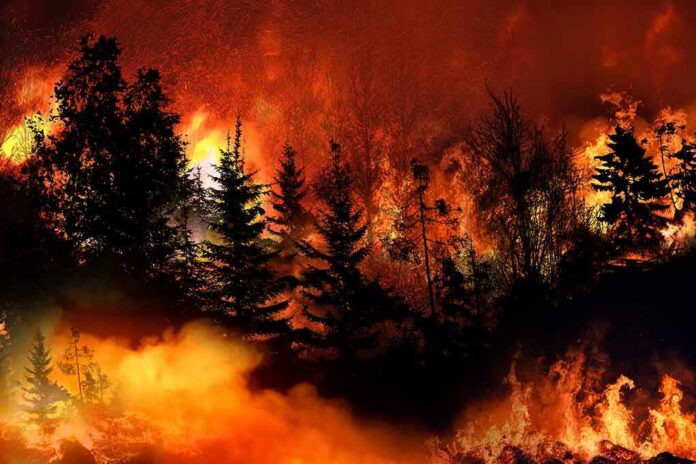
A Canadian freight train crew found themselves literally “encased in flames” as wildfires swallowed the tracks near a remote Ontario town, yet every worker walked away alive.
Story Snapshot
- CN Rail confirms all crew members escaped the fire near Armstrong, Ontario with no injuries.
- Viral cab video shows flames closing in on both sides of the train as workers call for help.
- Three trains carrying flammable cargo were halted and nearby communities faced mandatory evacuation orders.
- Mainstream outlets hyped “train trapped in fire” while key facts on safe evacuation and rail safety got buried.
Train Crew Surrounded By Flames But Escapes Unharmed
On the night of July 13, a Canadian National Railway freight crew was running near Armstrong, a small community north of Thunder Bay, when fast-moving wildfire flames suddenly closed in on both sides of their locomotive. Video shot from inside the cab shows trees and brush burning right up to the tracks as thick smoke cuts visibility to almost nothing. The crew can be heard warning that the fire “could potentially overtake us here,” and calling for urgent help as they assess how quickly conditions are changing around them.
One worker, identified only as Jody in shared clips, sums up the situation in a simple, chilling line: “We’re encased in flames now.” That audio, repeated across social media and cable channels, came from real-time radio chatter as the crew watched fire curl around the locomotive. Despite the terrifying scene, Canadian National Railway later confirmed that “the crew was safely evacuated from the area” and that every worker made it out without injury. Company officials said employees in the region were moved out as a safety measure once the danger became clear.
Rail Operations Suspended And Communities Ordered Out
The emergency on the tracks did not happen in isolation. Ontario Provincial Police in the North West Region reported that three Canadian National Railway trains carrying combustible and flammable materials were stopped and staged on the Allanwater Subdivision near Collins because of wildfire activity in the area. Officers said there was no immediate threat to public safety but stressed that police, firefighters, and railway officials were working together to monitor conditions and support safety measures around the halted trains.
At the same time, at least six communities, including Armstrong and nearby Gull Bay First Nation, were under mandatory evacuation orders due to the spread of fires in northwestern Ontario. More than a hundred wildfires were burning out of control in the region, pushing emergency services to focus on getting people out quickly instead of offering detailed public briefings on every single incident. Rail traffic around Armstrong was temporarily suspended as Canadian National Railway pulled workers from the area and assessed damage, adding another strain to critical supply routes already stressed by high fuel costs and global shipping problems.
Viral Video Hype Versus Hard Safety Facts
The first thing many people saw was not a safety report, but the dramatic cab video. Clips posted to Instagram and reshared by outlets from FOX Weather to The Weather Network show the inside of the locomotive as orange flames race past both windows, looking almost like a Hollywood disaster scene. Social media captions called the train “trapped” and “engulfed,” and some foreign outlets even labeled the situation “deadly” despite no loss of life and no reported injuries. Those words grabbed clicks but hid the most important fact: the crew survived.
A CN Rail train was halted near wildfire activity in Armstrong, located in northwestern Ontario, and employees recorded the tense moments when the flames surrounded them.
Watch more video: https://t.co/qncWz34CGx pic.twitter.com/KbCrZft6Tm
— The Weather Network (@weathernetwork) July 16, 2026
Major broadcasters pushed the fear angle hard, centering phrases like “crew caught in wildfire” and “terrifying footage from inside a train,” while the confirmation of a successful evacuation was mentioned only briefly or late in reports. One Canadian outlet said the crew abandoned the train and escaped on foot, while another reported the train was later allowed to proceed, creating confusion about what exactly happened to the locomotive. Canadian National Railway spokespeople have not yet released a full timeline or investigation-style incident report, leaving unanswered questions about the precise evacuation steps and how close the fire came to the train’s flammable cargo.
What This Incident Signals About Rail Safety And Fire Risks
Canadian rail lines have faced high fire risk before, including past cases where trains were stopped by flames or smoke and large groups of passengers had to be evacuated without serious injury. A recent federal review of fire risks in railway operations found that many reported fires start along the right-of-way, near tracks and rail equipment, and can be triggered or worsened by train activity in dry conditions. That means every mile of track running through forest or brush becomes a potential flashpoint when governments fail to manage fuels or when green activists block logging and controlled burns.
Rail companies are now investing in better predictive models and sensor networks to spot heat and smoke faster along remote stretches of track. But technology is only part of the answer. This Ontario case shows how much still depends on front-line workers making quick decisions under pressure and having clear, practiced evacuation plans they can carry out when radio calls turn urgent. For American readers watching from across the border, the incident is a sharp reminder of why strong infrastructure, reliable energy, and serious land management matter for both safety and our broader economy, especially when wildfire seasons grow longer and more intense.
Sources:
cbc.ca, instagram.com, toronto.citynews.ca, ctvnews.ca, kitchener.citynews.ca, thestar.com.my, youtube.com, timesnownews.com, rail.nridigital.com