

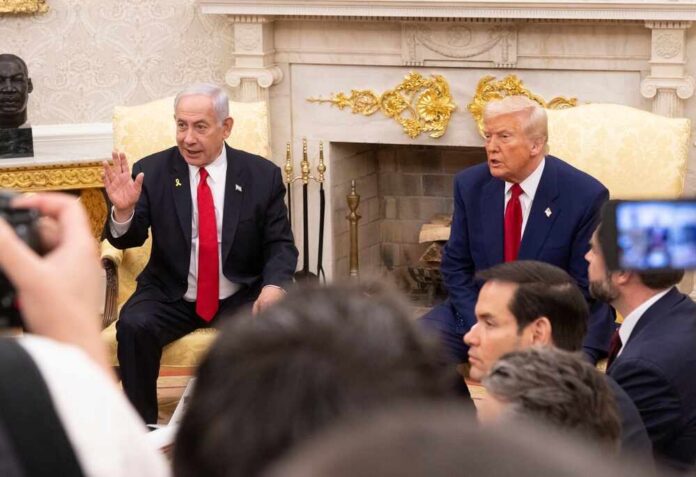
A once-reliable Republican consensus on Israel is cracking inside MAGA, and the fallout is turning into a power struggle over who speaks for “America First” in Trump’s second term.
Quick Take
- MAGA’s longtime pro-Israel alignment has split into “America First” skeptics and establishment “Israel First” defenders.
- Younger conservatives are driving much of the change, with polling showing sharply lower support for Israel’s Gaza operations among 18–34-year-olds.
- The fight is spilling into conservative institutions and donor networks, including tensions involving Heritage-aligned circles and pro-Israel advocacy groups.
- Trump has largely held to pro-Israel policy, while allies like JD Vance try to keep the coalition from fracturing.
A GOP Civil War Over Foreign Policy Priorities
President Trump’s second-term coalition is confronting an uncomfortable reality: “America First” does not automatically translate into unconditional support for Israel the way it often did in prior Republican eras. Since the Gaza war began in October 2023, conservative media personalities and some elected Republicans have publicly questioned U.S. policy, foreign aid, and the influence of lobbying groups. At the same time, traditional pro-Israel Republicans argue the alliance remains central to U.S. interests and Western security.
The tension is not just rhetorical. It’s now a defining test of what “America First” means when the GOP controls Washington: prioritize domestic needs and avoid foreign entanglements, or treat Israel as a strategic and moral commitment that justifies continued U.S. backing. That debate lands in the middle of voter frustrations about inflation, debt, and distrust of federal institutions—concerns that can intensify scrutiny of overseas spending even among voters who historically supported strong alliances.
A Generational Shift Is Reshaping the MAGA Base
Polling trends described in the research point to an age-driven fracture that Republicans can’t ignore. Gallup data cited in the report indicates only 32% of U.S. adults support Israel’s military actions in Gaza, while support among 18–34-year-olds across parties sits far lower. In that climate, Steve Bannon’s reported observation that there is “very little support for Israel” among under-30 MAGA members reads less like a provocation and more like a warning about the movement’s future electorate.
Social media has accelerated that shift by bypassing traditional news filters and pushing graphic, real-time war footage directly into feeds. That has changed how younger voters interpret the conflict and how quickly they challenge institutional talking points. For older conservatives, this creates a dilemma: many still see Israel through the lenses of shared security interests, religious affinity, and decades of Republican orthodoxy. Younger populists, meanwhile, more often frame the question around national interest, spending, and avoiding another “forever” commitment abroad.
Institutional Republicans Push Back—And Risk a Backlash
Establishment-aligned groups and leaders have responded forcefully, trying to separate legitimate policy debate from rhetoric they view as reckless or discriminatory. The research describes open conflict involving pro-Israel networks and conservative institutions, including a Heritage-related controversy that triggered staff backlash in late 2025. Events like the Republican Jewish Coalition summit—where attendees reportedly displayed messages rejecting Tucker Carlson as representative of MAGA—illustrate how hard institutional players are working to police the movement’s boundaries.
That approach carries political risk. When gatekeepers label broad swaths of dissent as unacceptable, they can unintentionally reinforce a belief shared by many voters on the right and left: that “elites” protect their own interests first and shut down debate second. At the same time, the research also highlights a real complication for the America First side: extremist figures can exploit the Israel debate to smuggle antisemitic themes into mainstream conversations. Keeping that line clear is essential for any coalition that claims to defend constitutional equality and ordered liberty.
Trump Holds the Line While Allies Try to Manage the Split
The report depicts Trump as largely unmoved by base-level criticism, maintaining pro-Israel policies even as the argument grows louder. That posture is consistent with Trump’s earlier record of high-profile pro-Israel moves, and it signals that institutional Republicans still have leverage inside the administration. Yet the same research suggests Vice President JD Vance has tried to answer questions about Gaza and U.S. support without offering blanket endorsements, reflecting a balancing act aimed at preventing the issue from splintering the broader governing agenda.
For Republicans in Congress, the immediate challenge is practical: disagreements over aid, conditions, and messaging can spill into committee fights and slow legislative coordination. For conservatives who want a limited, accountable government, the stakes are bigger than one foreign-policy dispute. The debate is exposing how easily Washington coalitions can fracture when voters demand tighter priorities, cleaner lines between lobbying and lawmaking, and a clearer explanation of what U.S. taxpayers are funding and why.
What to Watch Next as 2026 Politics Heat Up
Three dynamics will likely shape what happens next. First, the generational divide appears durable, and it may harden as more voters see foreign policy through the lens of debt, border security, and domestic renewal. Second, institutional counteroffensives could either stabilize the old pro-Israel consensus or deepen grassroots resentment if voters perceive censorship and donor-driven discipline. Third, the movement’s credibility will depend on whether leaders can allow rigorous debate while isolating genuine bigotry and extremist opportunism.
How Fight Over Israel Playing Out Inside MAGA… https://t.co/qEcch7UiUF
— SATANYAHU (@Outli3rThe) May 6, 2026
The bigger takeaway is that the Israel fight inside MAGA is really a test of sovereignty and trust—two themes that now dominate American politics across party lines. Conservatives angry about overspending and “forever wars” want proof that Washington can say no, even to powerful interests. Pro-Israel Republicans want proof that the U.S. can still lead strategically without retreating into isolation. With Trump in the White House and Republicans running Congress, voters will be watching whether the GOP governs like a majority—or fractures like an exhausted establishment.
Sources:
The Fight Over Israel Is Heating Up Inside the Trump Camp
MAGA Infighting Erupts as Heritage Row Exposes Divide on Israel
Why the MAGA movement is turning against Israel
The MAGA world was on the side of Israel. Now it is split over Gaza
MAGA is turning on Israel over Gaza, but Trump is unmoved