

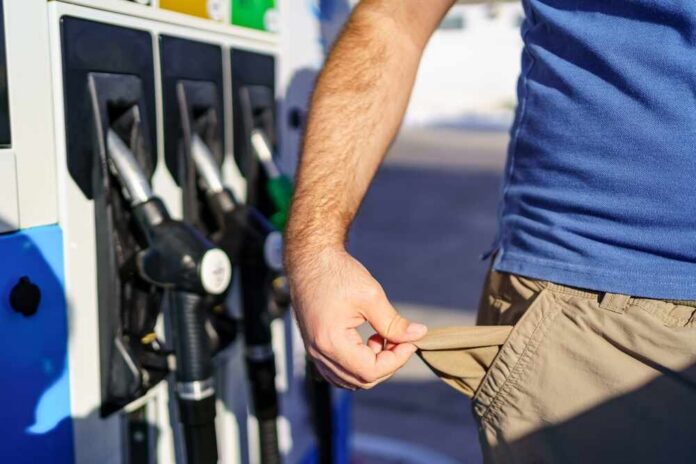
Americans are being asked to accept $4.40-plus gas as “worth it” for a war that’s already outlasting the timeline the White House once projected.
Quick Take
- President Trump defended the U.S.-backed conflict with Iran even as national gas prices climbed to roughly $4.39–$4.48 a gallon.
- The war has stretched into its third month despite earlier talk that it would last no longer than six weeks, leaving consumers uncertain about when relief arrives.
- A fragile ceasefire has not removed the oil-market “risk premium,” with the Strait of Hormuz remaining a focal point for supply fears.
- Democratic leaders are using pump prices to attack the war as “reckless,” while polling shows broad disapproval of the administration’s handling of prices.
Trump ties pump pain to national-security aims
President Donald Trump argued in early May that higher gasoline prices are an acceptable cost of the U.S. posture against Iran, even describing his decision as both potentially “foolish” and “brave” while insisting it was necessary. Trump also predicted that prices would fall sharply once the fighting ends, telling reporters gas will “drop like a rock” when the war is over. That promise, however, depends on an end date the public has not been given.
National averages reported across outlets have ranged from about $4.39 to $4.48 per gallon, with increases of roughly $1.50 to $2.00 since the conflict began. That kind of spike hits households quickly because fuel costs are paid weekly, not annually like many taxes. The administration’s argument is essentially a tradeoff: accept short-term consumer pain to pursue strategic objectives. Critics counter that families aren’t seeing a clear schedule for when “short-term” ends.
Why this war keeps showing up on your receipt
Oil prices react less to speeches than to risk, and the risk is concentrated in one geographic pinch point: the Strait of Hormuz. With U.S. forces reportedly guiding ships through the strait while Iran warns outside militaries to keep away, markets price in the possibility of disruption even when actual supply continues to move. A ceasefire may reduce immediate danger, but a fragile one still leaves traders and refiners building in a cushion—often felt most visibly at the pump.
Energy inflation also behaves like a tax on everything else. Diesel and gasoline feed directly into commuting, food delivery, farm inputs, and the logistics that keep store shelves stocked. Reporting cited behavioral changes as well, with polling indicating that 44% of Americans have cut back on driving because of costs. For conservatives who already resent years of high-cost energy policy debates, the point is practical: when energy is expensive, working families lose flexibility, and small businesses lose margin.
Timeline slippage raises credibility questions
The conflict is now in its third month, extending beyond earlier expectations that it would be over within six weeks. That gap matters politically and financially because the administration’s “prices fall when war ends” message becomes harder to evaluate when the finish line moves. A longer-than-forecast war also fuels the broader public suspicion—shared on right and left—that Washington is quick to start major initiatives but slow to explain clear objectives, costs, and exit plans.
Costs remain another uncertainty. One report described a Pentagon public estimate of $25 billion while citing sources who believe the true total could be roughly double, near $50 billion. Even if that higher number proves inaccurate, the presence of competing estimates highlights a recurring problem in modern governance: Americans are asked to trust headline figures without seeing a detailed, auditable accounting in real time. In an era of debt fatigue, that missing clarity becomes its own political liability.
Democrats seize on gas prices, but voters want answers from everyone
Senate Minority Leader Chuck Schumer and other Democratic leaders have framed the spike as the direct result of “Trump’s war,” staging events at gas stations and amplifying the message online. House Democratic Leader Hakeem Jeffries has pointed to pre-war prices under $3.00 per gallon to argue the conflict was a “war of choice.” Those attacks may energize the opposition, but they also underscore a wider reality: both parties default to messaging when families want measurable milestones, timelines, and accountability.
Trump argues rising gas prices are worth war with Iran https://t.co/xpYl5ss5PJ
— Stock Market News (@_StockMarkets) May 6, 2026
Polling cited in recent coverage shows deep dissatisfaction with the administration’s handling of rising prices, alongside broader disapproval on inflation and the economy. For Republicans who control Washington, that’s a warning that cultural victories and tough rhetoric do not substitute for cost-of-living stability. For Democrats, it’s a reminder that simply opposing Trump won’t fix energy price volatility tied to global chokepoints. The immediate policy test is whether leaders can reduce risk, restore predictability, and level with the public about tradeoffs.
Sources:
Trump economy approval sinks as gas prices rise, new poll shows
Fox News video report on gas prices, Iran conflict, and Strait of Hormuz developments