

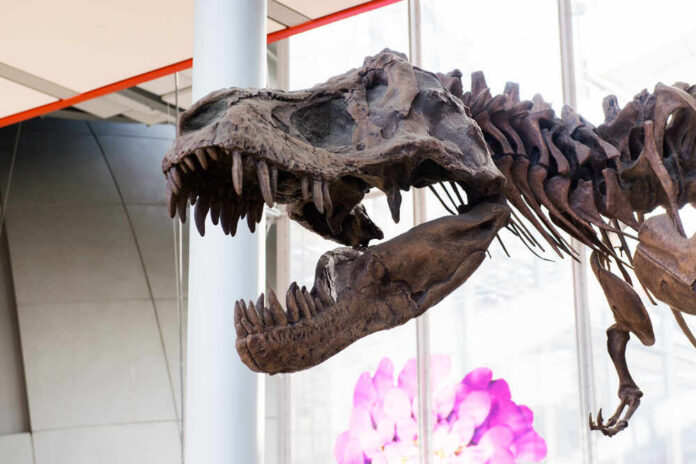
A 75-million-year-old fossil discovered in Montana reveals tyrannosaurs weren’t just fierce hunters—they scavenged carcasses like common vultures, shattering decades of scientific assumptions about these ancient apex predators.
Story Snapshot
- Fossilized tyrannosaur foot bone bears 16 precise bite marks from a smaller tyrannosaur feeding on a decomposed carcass
- Advanced 3D scanning confirms scavenging behavior, challenging the long-held image of tyrannosaurs as pure hunters
- Amateur fossil hunter’s Montana discovery leads to groundbreaking research at Aarhus University
- New analysis system provides unprecedented precision in documenting ancient feeding behaviors
Montana Discovery Rewrites Tyrannosaur History
An amateur fossil hunter’s discovery in Montana’s Judith River Formation has upended scientific understanding of tyrannosaur behavior. The fossilized metatarsal bone from a massive tyrannosaur, measuring 10-12 meters long and weighing several tons, was donated to North Dakota’s Badlands Dinosaur Museum. Josephine Nielsen, a master’s student at Aarhus University, analyzed the specimen using cutting-edge 3D scanning technology. Her findings, published in the journal Evolving Earth in 2024, document 16 distinct bite marks inflicted by a smaller tyrannosaur on a carcass that had already lost most of its flesh.
Technology Exposes Scavenging Evidence
Nielsen employed a sophisticated Circumferential Mark system using micro-CT scanning to quantify each bite’s depth and angle with unprecedented precision. The marks appeared on a foot bone containing minimal meat, eliminating any possibility the tyrannosaur was hunting live prey. No healing signs existed on the bone, confirming the animal was already dead when scavenged. Nielsen stated these bite marks came from “a smaller tyrannosaur that fed on a much larger relative” while “cleaning up an old carcass.” This technical approach eliminates the guesswork that plagued previous paleontological analyses, allowing researchers to “precisely document when and why” feeding occurred.
Opportunistic Feeders, Not Just Killers
The evidence contradicts Hollywood’s portrayal of tyrannosaurs as relentless killing machines. Late Cretaceous ecosystems in Montana, dating to approximately 75 million years ago, hosted tyrannosaurs like Daspletosaurus or Gorgosaurus alongside hadrosaurs and ceratopsians on floodplains. These predators operated efficiently by consuming every available resource, including bone remnants other scavengers left behind. The discovery parallels modern hyena behavior, where apex predators supplement hunting with opportunistic scavenging. This energy-efficient strategy makes evolutionary sense for massive animals requiring substantial caloric intake. Previous research on a 2009 Gorgosaurus fossil revealed juveniles hunted small prey before transitioning to larger game as adults, suggesting scavenging may have been particularly important for younger, less powerful individuals.
Implications for Scientific Understanding
The study refines biomechanical models explaining why tyrannosaurs evolved bone-crushing jaws capable of extracting marrow and nutrients from skeletal remains. Museums gain compelling exhibit material while paleontologists acquire a new analytical toolkit for examining bite traces on fossils. The research challenges educational narratives portraying these creatures solely as “king predators,” forcing revisions to textbooks and documentaries. Montana and North Dakota fossil tourism may benefit economically from increased public interest, with dinosaur exhibits generating over $100,000 annually for regional museums. The CM system Nielsen developed now serves as a standard for future bite trace analysis, advancing digital paleontology methodologies across the field.
While some experts previously cautioned about contamination in fossil traces, the 3D morphometric approach reduces subjectivity and strengthens conclusions about scavenging behavior. The Judith River Formation continues yielding fossils that reveal surprising aspects of ancient ecosystems. This discovery demonstrates how amateur contributions to science, combined with advanced academic analysis, produce insights that professional expeditions alone might miss. The specimen remains housed at the Badlands Dinosaur Museum, where ongoing studies may replicate these findings across other Judith River fossils, further documenting the flexible feeding strategies that helped tyrannosaurs dominate their environment for millions of years.
Sources:
75-Million-Year-Old Mystery: Scientists Uncover Tyrannosaurs’ Dark Secret
Fossil of tyrannosaur from 75 million years ago reveals its diet
Dinosaur Fossil Found That Appears to Contain 75-Million-Year-Old Blood Cells