

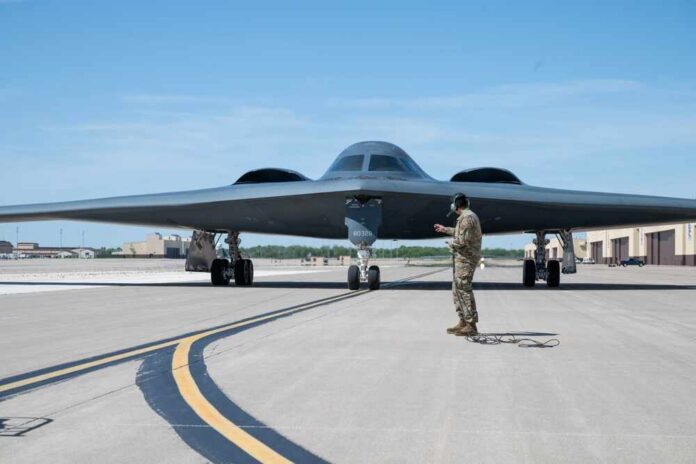
Chinese state-linked scientists say their missiles “killed” America’s new B-21 Raider in a lab wargame — but the details actually show how hard taking down this stealth bomber will be in the real world.
Story Snapshot
- Chinese researchers ran a computer simulation where Mach‑6 hypersonic missiles shot down a B‑21‑like bomber.
- The study admits the B‑21 was very hard to detect and dodge, and needed exotic tactics to be hit.
- U.S. and allied analysts say the model used guesses, not real B‑21 data, and proves little about combat.
- The episode shows China’s propaganda race against America’s next‑generation stealth, not a true B‑21 “kill.”
China’s hypersonic ‘B‑21 kill’ claim and what the simulation really did
Chinese media and researchers are boasting that they have already “shot down” America’s new B‑21 Raider, even though the bomber is still years away from full service. Their claim comes from a computer simulation, not a real shoot‑down. A team at Northwestern Polytechnical University in Xi’an modeled an air battle where Chinese fighters and drones used a hypersonic air‑to‑air missile to target a B‑21‑like stealth bomber and its loyal wingman drone. The missile was said to reach speeds near Mach 6 and follow a high, near‑space trajectory before diving down. In the scenario, the B‑21 detected the first missile and performed smart evasive maneuvers, avoiding the initial attack. Only after Chinese controllers retasked a second hypersonic missile mid‑flight — switching its aim from the U.S. drone to the bomber — did the simulated B‑21 get “shot down.”
The study, described in Chinese and foreign reports, was published in the peer‑reviewed journal Acta Aeronautica et Astronautica Sinica, sometimes translated as the Journal of Aerospace. The Chinese team said the key was keeping constant communication links with the hypersonic missiles, even at very high altitude and speed, so they could trade data with aircraft and drones and change course on the fly. They also claimed to use a “conformal skin” stealth fighter — a jet covered with smart sensors — to pick up the B‑21’s faint heat and electrical signals, cueing the missile toward the target. Even in their own telling, the B‑21 only goes down after a complex, coordinated attack using multiple advanced systems acting together at just the right time.
Why the B‑21 remains a nightmare target for China in the real world
Analysts in the United States and allied countries quickly pointed out what this simulation really shows: how difficult killing the Raider will be, not how easy. The B‑21 is designed as a very‑low‑observable stealth bomber with advanced shaping, materials, thermal management, and powerful electronic warfare systems that make long‑range tracking extremely hard. Even the Chinese study reportedly acknowledges that the B‑21 is “difficult to defeat” and can jam or confuse many normal air and ground radars. That is why the Chinese team had to rely on a missile launched from near space, flying a special “surprise” path and guided by constant data links, rather than standard air defenses. Western experts also stress that the Chinese model used public images and broad estimates of B‑21 performance, not classified design data, and it has never been proven in live‑fire tests.
Defense writers note that this is not China’s first computer victory over U.S. stealth aircraft. Over the past several years, Chinese research groups have published similar “wins” against the F‑22, the F‑35, and now the B‑21, almost always based on software models and ideal conditions. In each case, Chinese sources present the results as proof that American stealth can be beaten, while Western specialists say the simulations leave out many real‑world factors like weather, electronic warfare tricks, decoys, changing flight paths, and the fog of war. One review of the B‑21 simulation said it “raises more questions than answers” and warned that China’s opaque military system makes such claims hard to check. In plain language, Beijing can run as many video‑game victories as it wants; what matters is what happens when real missiles meet a real Raider in the sky.
Information war: why Beijing talks up ‘B‑21 killers’ and what America should do
This latest story also fits a wider pattern: China’s leaders want their people, and America’s allies, to believe U.S. weapons are already outdated. By pushing headlines that their hypersonic missiles can swat down the B‑21, they try to blunt the bomber’s deterrent power and boost their own image at home. The university that led the study, Northwestern Polytechnical University, is under United States sanctions because of its ties to the Chinese military. That connection raises more questions about whether the main goal of such papers is honest engineering, political messaging, or both. For Beijing, every claimed “flaw” in U.S. stealth helps sell the idea that China is catching up or has already pulled ahead.
For Americans who care about national defense, this cuts two ways. The story is a reminder that China is pouring money into hypersonic weapons and advanced sensors aimed straight at U.S. power. It would be foolish to shrug that off or let Congress starve the B‑21 program, missile defenses, or next‑generation fighters after years of waste on woke pet projects and bloated domestic spending. At the same time, nothing in the Chinese simulation proves that the B‑21 is a “sitting duck.” If anything, it shows Beijing knows the Raider is a serious problem, and that they must stack the deck in a lab model just to bring it down even once. The Trump administration’s task is clear: keep America’s edge real, not virtual, by funding hard testing, counter‑hypersonic defenses, and the stealth bomber force that gives our country a long‑range punch no simulation can erase.
Sources:
avweb.com, scmp.com, bulgarianmilitary.com, nationalinterest.org, futurezone.at, voachinese.com, asiatimes.com