

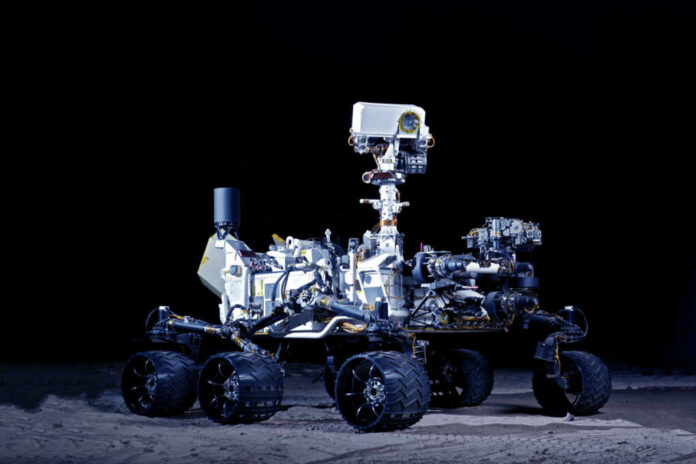
A U.S. robot just became a record‑setting “marathon finisher” on Mars, even as many Americans feel Washington can barely go the distance here at home.
Story Snapshot
- NASA’s Perseverance rover has driven a full marathon distance of about 26.2 miles on Mars, becoming only the second machine in history to do so on another world.
- The rover hit 26.218 miles (42.195 kilometers) on mission sol 1,890, equal to five years and four months after landing in Jezero Crater.
- Orbital photos from the Mars Reconnaissance Orbiter show Perseverance as a tiny green speck with its wheel tracks on the Martian surface, confirming the path of this robotic explorer.
- Perseverance reached the marathon mark in less than half the time of its predecessor Opportunity, while continuing to search for signs of ancient life in Martian rocks and soil.
Perseverance Becomes a Martian Marathon Finisher
NASA has confirmed that its Perseverance rover has now driven the distance of a full marathon on the surface of Mars, a milestone that reminds many Americans of what our country can achieve when government focuses on core missions like science and exploration, not social engineering. On June 14, 2026, the six-wheeled rover’s odometer passed 26.2 miles, the classic marathon distance, after more than five years exploring Jezero Crater’s ancient terrain on the Red Planet.
Mission logs show that Perseverance reached exactly 26.218 miles, or 42.195 kilometers, on its 1,890th Martian day, known as a “sol,” matching the official marathon standard runners use on Earth. NASA’s Astronomy Picture of the Day for June 27 highlighted the achievement and tied it to that sol count, giving the public a clear, trackable record of how far the rover has traveled since touchdown in February 2021, early in President Trump’s first term.
Orbital Photos Back Up the Numbers from Mars
To back up the distance claim, NASA released a high-resolution image from the Mars Reconnaissance Orbiter showing Perseverance as a small green dot on the crater floor, with faint wheel tracks tracing its journey across the landscape. The picture was captured on June 13, 2026, just one day before the rover crossed the marathon finish line, and the agency’s Jet Propulsion Laboratory explained that the rover had reached the 26.2-mile mark by June 14, confirming the milestone from orbit as well as from the rover’s own data.
That orbital view matters because it offers an independent way to confirm what NASA’s engineers see in their telemetry, countering the online conspiracy chatter that often tries to dismiss American space achievements as staged. The track pattern on the ground lines up with years of reported drives around Jezero Crater, where Perseverance has been slowly climbing over rocks, sand, and ridges while stopping to drill core samples from ancient river delta deposits that might hold chemical clues to past microbial life, the kind of careful work that builds trust in real science over internet rumor.
Record Time Compared with the Opportunity Rover
Perseverance is only the second rover ever to cover a marathon distance on another world, following NASA’s Opportunity rover, which needed roughly 11 years and two months to reach the same mark back in 2015, more than twice as long as this newer machine. NASA scientists note that the five-years-and-four-month timeline for Perseverance reflects major advances in autonomous navigation, with software that lets the rover safely plan its own paths for many daily drives while engineers oversee the bigger route decisions from Earth.
NASA's Perseverance rover just ran a marathon on Mars. It finished in half the time of the previous record holder. Its top speed is 0.1 miles per hour.
On June 14, 2026, Sol 1,890 of its mission, Perseverance crossed 26.2 miles (42.195 kilometres) of total driving on the Martian… pic.twitter.com/jbQP87HWXy
— The Modern Pulse (@manavspeakfacts) July 14, 2026
Engadget and other outlets reported that NASA marked the moment by pointing out how the rover’s top speed is only about one-tenth of a mile per hour, meaning this marathon is a slow, grinding climb over alien ground rather than a sprint, and still the robot has outperformed its veteran predecessor by a wide margin. That kind of patient, steady progress is a sharp contrast to the rushed, short-sighted spending Americans see in many other parts of the federal government, and it shows what happens when talent and resources are focused on a clear mission instead of fashionable political agendas.
What the Martian Marathon Means for America
The rover’s marathon comes as the United States continues to face high costs at home, from energy and food to housing, pressures that many blame on years of overspending, green mandates, and globalist trade deals that favored foreign interests over American workers, yet this mission is a reminder that not every federal dollar is wasted when leaders choose projects that advance hard science, strengthen national pride, and support the kind of engineering jobs that keep our country on top in space. Perseverance’s work also feeds into future planning for crewed missions, giving planners better maps, rock data, and operational lessons that could protect American astronauts on the ground.
The mission sits in a long tradition that began with the Apollo landings, which have been attacked for decades by conspiracy theorists but are supported by clear physical evidence, such as returned moon rocks and laser reflectors still used to measure the distance to the Moon with pinpoint accuracy. Space researchers point out that the more independent lines of evidence there are for a mission—like rover data, orbital pictures, and public logs—the harder it is for bad-faith actors to claim a hoax, a lesson that applies not just to Mars but to every serious debate where citizens want facts, not spin.
Sources:
morningoverview.com, science.nasa.gov, apod.nasa.gov, spacedaily.com, smithsonianmag.com, academic.oup.com