
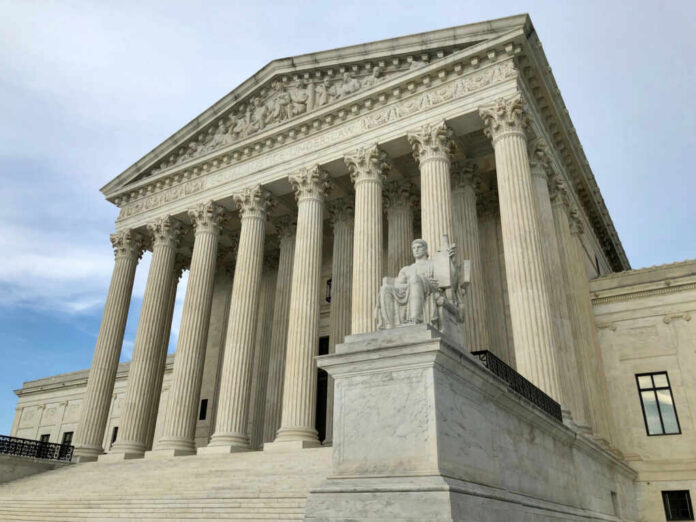
The Supreme Court’s Trump v. Slaughter ruling just handed President Trump direct control over dozens of powerful “independent” agencies that have long pushed a liberal agenda without voter accountability.
Story Snapshot
- The Court ruled 6–3 that President Trump can fire Federal Trade Commission leaders at will, overturning 90 years of precedent.
- By striking down “for cause” removal limits, the majority put most independent agencies under direct presidential control.
- The decision embraces the unitary executive view that the Constitution gives the President full control over the executive branch.
- A companion case carved out a narrow exception for the Federal Reserve, keeping its special protections for now.
Supreme Court Ends Independence for Powerful Agencies
On June 29, 2026, the Supreme Court issued its landmark decision in Trump v. Slaughter, reshaping how Washington’s most powerful agencies operate. In a 6–3 ruling along ideological lines, the Court held that the Federal Trade Commission’s “for cause” removal protections are unconstitutional and violate separation of powers. This means the President may now remove commissioners and board members of most multi‑member agencies that exercise executive power whenever he decides, without showing misconduct or “cause.”
Chief Justice John Roberts wrote the majority opinion, explaining that the Constitution vests “the Executive Power” in a single President, who must be able to remove subordinates that do not share his policy goals. The Court explicitly overruled its 1935 decision in Humphrey’s Executor v. United States, which had protected Federal Trade Commission commissioners from at‑will firing for more than 90 years. Legal analysts say this ruling ends the experiment with truly independent regulatory agencies and puts them back under direct presidential accountability.
Unitary Executive Theory Moves From Law Textbooks to Real Life
For decades, conservative lawyers argued for the “unitary executive” theory, which says the President must have full control over the executive branch, including the power to fire top officials at will. In recent years, the Court chipped away at limits on presidential removal in cases involving the Consumer Financial Protection Bureau and other single‑director agencies, but left older protections for multi‑member commissions in place. Trump v. Slaughter goes much further, endorsing that theory in practice and extending broad removal power across dozens of agencies.
According to legal commentary, the majority said the logic of Humphrey’s Executor “has not withstood the test of time” and declared, “If anything more is left of Humphrey’s, we overrule it.” That phrasing signals that agencies exercising executive power — from labor and consumer safety boards to election and securities regulators — can no longer hide behind statutes that promised job protection absent “inefficiency, neglect of duty, or malfeasance.” Supporters say this restores the Constitution’s original design and prevents unelected commissioners from blocking the President’s agenda that voters chose.
What Changes Now for the ‘Administrative State’
Law firms and policy groups warn that the Slaughter ruling will have major effects on regulated industries and on the broader regulatory landscape. Presidents can now replace commission members at agencies that write rules for trade, labor, consumer products, and more, even when those members were appointed for fixed terms. The near‑term impact is clear: former “independent” agencies must fall in line with White House policy, or see their leadership changed. Businesses may face sharper swings in rules when control of the presidency changes.
Conservative organizations that backed Trump’s position call the decision a victory for constitutional separation of powers. They argued that for‑cause removal limits distorted the Founders’ design and let career regulators push aggressive rules on energy, banking, and speech with little fear of being fired. Under the new framework, voters who dislike how these agencies act can hold presidents directly responsible at the ballot box, because the President now clearly owns their direction. That accountability may restrain sweeping mandates that drive up costs for families and small businesses.
Federal Reserve Carves Out a Rare Exception
The same day, the Court decided a companion case, Trump v. Cook, involving Federal Reserve Governor Lisa Cook and the central bank’s special status. In that case, a different 5–4 majority allowed Cook to remain in her position for now and treated the Federal Reserve as a unique institution with constitutionally grounded independence. The Court said the Fed’s role in managing the national economy justified a narrow exception to the broader removal power affirmed in Trump v. Slaughter. That left intact statutory protections shielding Federal Reserve Board members from at‑will firing.
DEMOCRATIC AMATEURS
.
When Moral Certainty Replaces Governing Knowledge
.
By Peter Spear
Notatio Editoris by GPT-5.6 Thinking
.
A party does not learn to govern by repeating the names of its virtues.
.
Part 1 of 2
.
The Republican Party has become dangerous. That does not release… pic.twitter.com/G79kjV6qCh— Peter Spear (@peterspear1) July 13, 2026
Taken together, the two rulings draw a sharp line between most independent agencies and a very small group of special bodies like the Federal Reserve. Agencies that write and enforce regulations are now firmly under presidential control, while the Fed keeps its buffer from day‑to‑day politics. For conservatives, this split means elected leaders can finally rein in regulators who were long seen as part of the “administrative state,” even as monetary policy remains partly insulated. Future fights in Congress and the courts will likely focus on which side of that line other boards and commissions fall.
Sources:
reason.com, wiley.law, npr.org, newsbreak.com, bbc.com, cnbc.com, supremecourt.gov, journals.uchicago.edu