
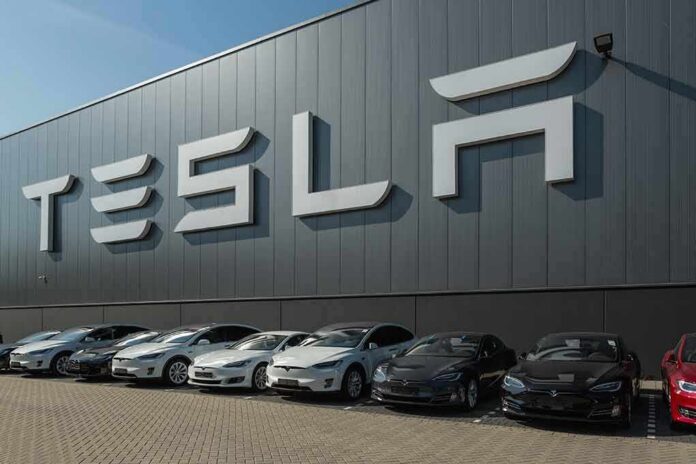
A Tesla Roadster prototype used SpaceX-style thrusters to lift off, roll in the air, and land at a Texas test site — a real, recorded hop that has ignited a fierce fight over what counts as a “flying car.”
Story Highlights
- Reporters say the prototype briefly flew forward, rolled, and landed using cold-gas thrusters.
- The test ran at SpaceX’s McGregor site under a Federal Aviation Administration flight restriction.
- Coverage says the flight was short, unoccupied, and not approved for public-road use.
- Skeptics call it a stunt, not proof of a practical flying car for consumers.
What Tesla Demonstrated At The SpaceX Site
Car and Driver reported that a Tesla Roadster prototype lifted off, moved forward, performed a barrel roll, and returned to the ground. The story tied the maneuver to SpaceX-supplied cold-gas thrusters and cited claims of strong thrust output. Audacy described a combined fan suction and thruster setup that let the car climb a curved ramp, hang inverted, launch, rotate, and land. Together, the reports establish that a brief, controlled airborne hop occurred at a test venue in Texas.
MotorTrend pointed to a Federal Aviation Administration notice that restricted airspace around SpaceX’s McGregor facility during the event. The restriction covered a 1.5 nautical mile radius and extended up to 10,000 feet, matching a planned, unusual flight-related test. That detail supports that regulators expected airborne activity on site. It also shows the difference between a controlled test range and normal public streets or skies, where approval and safety rules are much tighter.
How The Thrusters Work — And What They Do Not Prove
Reports describe cold-gas thrusters, not liquid-fueled rockets. Cold-gas systems release high-pressure gas through nozzles for short bursts of push. That fits a car demo that hops, spins, and lands in seconds. Wired said the vehicle flew only a few dozen feet and carried no human during the stunt. WPXI noted Tesla’s own fine print saying the rocket setup is not approved for public roads. Those facts limit what the demo can claim about daily use.
Development Today said the airborne Roadster was unoccupied and flagged open questions about Federal Aviation Administration approval for any consumer use. The report noted unclear regulatory classification and certification routes. That aligns with a long history in which prototypes can fly but still face legal and safety gates before public operation. In short, the test showed capability in a controlled setting, not a path for owners to use it on highways or in shared airspace yet.
What Regulators Would Likely Require Next
Federal rules separate cars from aircraft, and anything that leaves the ground can fall under aviation oversight. MotorTrend’s review of airspace limits and the visible test controls hint at that reality. A vehicle seeking routine flight would likely need some form of experimental or special airworthiness approval and rules for where and how it can operate. That process takes time, data, and repeatable safety results that go well beyond a single, short aerial flip.
STATE NEWS | ‘A rocket car’: Elon Musk unveils new flying Tesla Roadster in McGregor pic.twitter.com/0Gievz3orJ
— KTRE News (@KTREnews) October 16, 2026
The conservative takeaway is simple: innovation should not stall under red tape, but safety rules must be clear and applied evenly. This prototype proved a narrow claim — brief, controlled hops appear possible. The road to consumer use still runs through the Federal Aviation Administration, state law, insurance, and common-sense limits. Lawmakers should press agencies to define fair paths that reward real engineering while protecting families from reckless rollout or politicized regulation.
How To Read The Hype Versus The Facts
Media reactions split fast. The Verge praised the show but called it just a stunt, not a product you can buy and use freely. Michael Thompson of Skyfly argued cold-gas thrusters give only seconds of lift and do not advance practical flying cars. Those takes focus on what was not shown: a passenger on board, sustained flight, and legal use between real places. They are fair cautions, but they do not erase the observed, documented hop itself.
Readers should separate three things. First, what happened: a Roadster prototype used onboard hardware to go airborne and land under control at a test site. Second, what it means now: it is a prototype, unoccupied, and limited to a controlled range with no civilian approval. Third, what could come next: deeper testing, published telemetry, and a clear, public certification path. Those steps would move the story from showpiece to something drivers and pilots can actually use.
Why This Matters For American Leadership
American energy, manufacturing, and aerospace know-how thrive when clear rules and strong competition meet real engineering. President Trump’s administration has pushed to cut red tape and bring jobs and innovation back home. This spectacle showed promise and also the hurdles ahead. The right move now is sunlight: release hard data, repeat tests with safety guards, and work openly with the Federal Aviation Administration. That mix protects families and keeps America first in advanced mobility.
Sources:
qlauson.com, newsweek.com, audacy.com, wired.com, motortrend.com, developmentstoday.com, wpxi.com, teslarati.com