
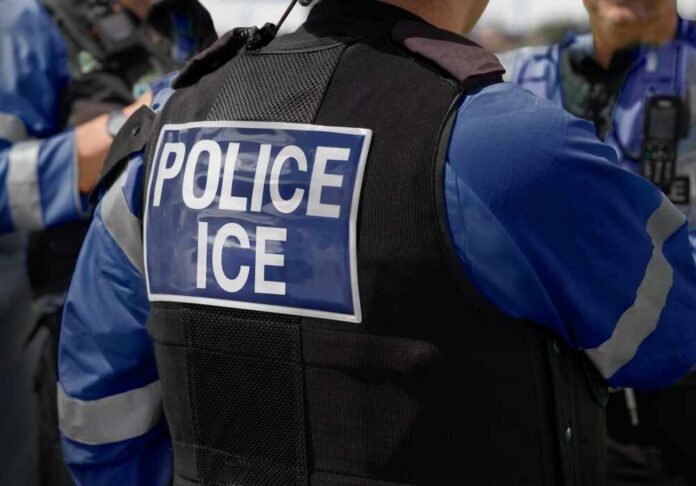
A routine ICE stop in California turned into a life-or-death confrontation that now raises hard questions about border enforcement, officer safety, and whether federal intelligence is reliable enough to justify split-second decisions.
Story Snapshot
- Federal prosecutors charged Carlos Ivan Mendoza Hernandez, a 36-year-old Salvadoran national living near San Francisco, with assaulting a federal officer using a vehicle as a deadly weapon.
- Authorities say the suspect struck an ICE agent, hit a law-enforcement vehicle while reversing, and tried to ram additional agents during a targeted stop in Patterson, California.
- Agents fired on Mendoza Hernandez during the encounter; he was hospitalized with multiple gunshot wounds and later arrested by the FBI after he recovered enough for custody.
- The defense disputes key claims, including alleged 18th Street gang ties and a DHS assertion about an El Salvador murder-related warrant, pointing to an El Salvador court acquittal document.
- Dashcam video reportedly exists but lacks audio, leaving unanswered questions about commands, timing, and the precise moment deadly force was used.
Charges follow a violent encounter during a targeted ICE stop
Federal authorities say the incident began during a targeted vehicle stop in Patterson, about 70 miles southeast of San Francisco, when ICE agents attempted to detain Carlos Ivan Mendoza Hernandez. Investigators allege he struck an ICE officer with his vehicle, reversed into a law-enforcement vehicle, and then attempted to ram two additional agents, forcing evasive action to prevent serious injury or death. Prosecutors charged him with assault on a federal officer with a deadly weapon.
Law enforcement responded with gunfire, striking Mendoza Hernandez multiple times, according to reporting that cites both the criminal complaint and statements from his attorney. He suffered gunshot wounds to the mouth, left arm, left leg, abdomen, and right side, and he was hospitalized—reportedly in intensive care—before being taken into custody. The FBI arrested him after he recovered from his injuries, and the Justice Department announced the charge the following day.
Disputes over gang allegations and an alleged foreign warrant
Federal officials described Mendoza Hernandez as an illegal immigrant suspected of ties to the 18th Street gang and claimed he was wanted in El Salvador for questioning related to a murder. His defense attorney has pushed back, saying he has found no evidence of gang membership and arguing the warrant narrative does not match a court record from El Salvador. That document, as described in reporting, shows Mendoza Hernandez was acquitted of murder charges in 2019.
This clash matters because “gang ties” and “wanted for murder” are not minor labels in immigration enforcement; they shape how the public understands risk, and they can influence how operations are planned on the ground. At the same time, the research available here does not independently confirm what information DHS relied on to make its claims, or whether the alleged intelligence was current, mistaken, or misunderstood across agencies. The result is a credibility gap that fuels distrust on all sides.
What the dashcam footage can—and can’t—settle
Dashcam footage obtained by a local outlet reportedly shows the encounter, but the video has no audio, and reporting says it remains unclear when shots were fired or what verbal commands were given. That missing context is central: an officer-safety case often turns on whether a suspect received clear lawful orders, whether officers faced an imminent threat, and whether there was time or space to disengage. Without audio, interpretations can harden into politics instead of evidence.
Why this case resonates beyond one traffic stop
Republicans controlling Washington in 2026 has not eliminated the core tension: voters want immigration laws enforced, but they also expect competence, transparency, and restraint when lethal force is used. Cases like this can become flashpoints because Americans simultaneously worry about violent resistance to law enforcement and about bureaucracies that can get identity, warrants, or affiliations wrong. The public also sees a familiar pattern—competing narratives, partial video, and delayed clarity—feeding suspicion that government institutions protect themselves first.
Illegal immigrant suspected of gang ties arrested after allegedly ramming ICE officer https://t.co/bwPKGwwvcR #FoxNews
— Rob Beto Aragon🇺🇸🇮🇱🇻🇦 (@gopwillrise) April 14, 2026
For conservatives, the alleged use of a vehicle against federal officers underscores the risks ICE agents face during targeted operations, and it strengthens the argument that immigration enforcement is not an abstract policy debate but a public-safety mission. For skeptics of aggressive enforcement, the unresolved questions about commands, tactics, and disputed background claims keep concerns about accountability alive. The next concrete milestones will be the initial court proceedings, evidentiary disclosures, and any clarified documentation on gang affiliation and warrant status.
Sources:
Illegal immigrant suspected of gang ties arrested after allegedly ramming ICE officer
Attorney says man shot by ICE in Stanislaus County is not gang member