
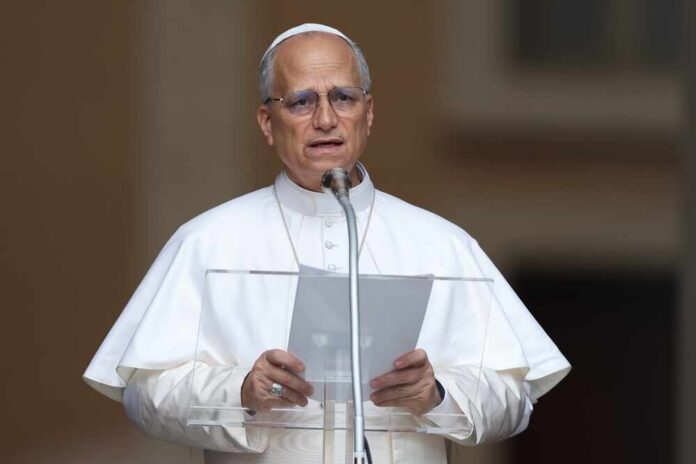
A rare public clash between a U.S. president and the first American pope is escalating into a test of who gets to define “peace,” “justice,” and America’s role abroad.
Quick Take
- President Donald Trump blasted Pope Leo XIV as “very liberal” and “weak on crime” after the pope’s public anti-war message amid U.S.-Iran ceasefire talks.
- Trump’s criticisms mixed foreign policy, domestic crime politics, and culture-war language, including claims the pope “caters to the Radical Left.”
- Pope Leo declined to engage, saying he has “no intention to debate” and that his message remains focused on promoting peace.
- Reports circulating about a Vatican meeting with an Obama adviser are not substantiated by the provided mainstream coverage; the documented trigger was the pope’s prayer vigil remarks.
Trump’s broadside targets the pope’s politics, not his theology
President Donald Trump took direct aim at Pope Leo XIV in a Truth Social post and in remarks to reporters, describing the pontiff as “very liberal” and accusing him of being “weak on crime” and “terrible for foreign policy.” The comments landed Sunday evening and then carried into follow-up press interactions. Trump also contrasted the pope with the pope’s brother, Louis Prevost, whom Trump reportedly praised as “all MAGA.”
Trump’s critique extended beyond personality into policy, folding in disputes over Iran, Venezuela, and pandemic-era approaches. In the reporting provided, Trump framed the conflict as the pope aligning with left-wing politics rather than acting as a neutral moral voice. That framing resonates with many conservative voters who feel elite institutions regularly scold ordinary citizens while avoiding accountability for rising disorder, high costs, and national insecurity.
Pope Leo XIV’s vigil condemned war rhetoric as “omnipotence”
Pope Leo XIV, the first U.S.-born pontiff from Chicago, drew attention Saturday during a prayer vigil at St. Peter’s Basilica by warning against a “delusion of omnipotence” in war rhetoric. Reports describe the pope urging a rejection of “sword, drone, vengeance,” emphasizing dignity, understanding, and forgiveness. The remarks came as U.S.-Iran ceasefire negotiations and related talks were underway, giving the pope’s message immediate geopolitical relevance.
Several accounts also describe the pope criticizing extreme rhetoric and invoking religious imagery to condemn bloodshed, placing him in visible tension with political leaders prosecuting or justifying military operations. Trump, for his part, has defended “America First” decision-making as necessary to protect Americans and deter adversaries. For conservatives focused on national sovereignty and public safety, the dispute underscores a familiar question: when clergy speak about conflict, does it guide conscience—or drift into partisan pressure?
The unverified “Obama adviser meeting” claim doesn’t match the documented trigger
Some coverage and social media chatter has circulated a claim that Trump’s attack followed a Vatican meeting with an Obama adviser. In the research supplied here, however, the clearly documented sequence is different: the pope delivered the vigil message on Saturday, Trump posted and spoke critically on Sunday, and the pope responded Monday while traveling. The mainstream reports summarized do not establish the alleged meeting as the catalyst, so readers should treat that claim cautiously.
That distinction matters because trust in institutions is already thin across the electorate. Conservatives often see coordinated “elite” networks shaping narratives behind closed doors, while many liberals see Trump’s rhetoric as destabilizing and needlessly personal. When an allegation can’t be anchored to the specific reporting at hand, it becomes a distraction from the verifiable issues actually driving the confrontation: war powers, national security, the moral language surrounding violence, and the growing habit of treating every institution as a political combatant.
Leo refuses the fight, but the underlying political collision remains
Pope Leo responded aboard a papal flight beginning an 11-day Africa trip, saying he had “no intention to debate” Trump and stressing, “I am not a politician.” That approach de-escalates the personal back-and-forth, but it doesn’t resolve the deeper conflict over legitimacy. Trump is asserting democratic mandate and executive responsibility; the pope is asserting moral authority and the power of public witness, especially during war and fragile ceasefire diplomacy.
Trump attacks Pope Leo XIV after Vatican meeting with Obama adviser – LifeSite https://t.co/1UBBJUirRW
— Linda Reis (@linda6reis) April 13, 2026
Politically, the episode may sharpen divisions among U.S. Catholics and widen the gap between Trump-aligned evangelicals and Vatican leadership. Socially, it adds fuel to a broader argument over whether major institutions—media, universities, corporate HR, and now even the papacy—are drifting into ideological messaging that many Americans never voted for. The immediate facts show a president and a pope talking past each other; the larger story is how quickly moral language becomes political ammunition.
Sources:
Trump unleashes tirade against “weak,” “terrible” Pope Leo
Donald Trump attacks Pope Leo XIV in Truth Social rant
Trump lambasts Pope Leo XIV, extending feud over Iran war