
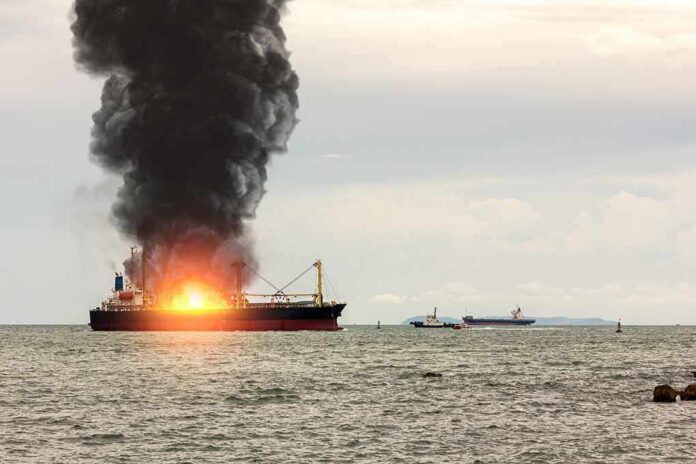
A British swimmer cutting through the Strait of Hormuz reported explosions and burning ships as a Panama-flagged tanker attack left sailors hurt and one missing, underscoring how hostile waters now threaten global energy lanes and civilian lives.
Story Snapshot
- India confirmed casualties after an attack on LPG tanker MT TARA GAS near Oman.
- Greenpeace-linked monitoring mapped hundreds of oil slick events across the region.
- United Kingdom Maritime Trade Operations flagged Hormuz as “severe” for hostile action.
- A swimmer said he saw a nearby tanker in flames and smelled chemicals during his crossing.
Confirmed Attack On Commercial Tanker Endangers Crew
India’s Ministry of External Affairs said the Panama-flagged liquefied petroleum gas tanker MT TARA GAS was attacked on November 16, 2026, off Oman. Twenty-one Indian crew were evacuated, two were hospitalized, and one remained missing. India condemned the strike and called the continuing targeting of ships a grave threat to civilian seafarers and free navigation. The statement did not detail spill volume or environmental impact from the tanker, but it documented human harm and evacuation steps.
Indian and international press echoed the government’s language on safety and free passage. Reports highlighted that all 24 crew were Indian nationals and that search efforts continued for the missing sailor. The coverage reinforced that these waters carry civilian workers who keep global trade moving, not just flags and hull numbers. Officials urged an end to attacks so cargo and crews could move through the internationally critical chokepoint without fear.
Swimmer’s Eyewitness Account Puts Viewers In The Fire Line
An endurance swimmer crossing the strait described hearing two loud blasts and seeing a tanker about four kilometers away engulfed in flames, with fireballs rising and a sharp chemical smell in the air. His account aligns with a pattern of recent strikes on commercial vessels in the waterway. The testimony did not name the ship or cargo chemistry, so it cannot prove a spill. It does, however, match the reality of nearby attacks and the sensory shock they cause for anyone on the water.
Such first-hand details matter because they capture how fast a routine crossing can turn into a survival decision. Mariners train for fire and abandon-ship. A solo swimmer does not. The report of blasts, visible flames, and strong odors suggests a burning fuel or gas event close enough to overwhelm the senses. That experience mirrors what crew face during projectile hits: noise, heat, confusion, and split-second choices, even when a vessel does not sink or release large volumes of oil.
Maritime Risk: Mining Concerns, Engine-Room Hits, And Jamming
The United Kingdom Maritime Trade Operations rated the Strait of Hormuz “severe,” citing a high likelihood of hostile action, interference with navigation, and potential mining activity. It also recorded 25 incidents since July that damaged engine rooms. Those hits can cripple propulsion and steering, raising the chance of collision or grounding. Nearly 40 percent of attacked ships later continued their voyages, which shows resilience, but does not erase the danger crews faced during and after impact.
The United Kingdom Maritime Trade Operations further reported stretches with only one confirmed cargo transit in a day and flagged persistent global positioning system jamming and electronic interference. Navigation systems that wander or go dark raise collision risks and slow rescue responses. One advisory described a liquefied natural gas tanker that took a projectile hit to the engine room, sparked a fire, and reported no environmental impact after it was put out. That outcome is a relief, but it is not a guarantee for the next ship.
Oil Slick Mapping And What The Data Does And Does Not Prove
Greenpeace-linked satellite monitoring identified more than 500 oil-spill instances across the Gulf, the Strait of Hormuz, and the Arabian Sea since the conflict began. Analysts added up daily slick footprints to a rough total area about the size of Wales. The group said some slicks linked to attacks while other origins were unclear. That means the maps support the claim of widespread pollution signals, but they cannot say every slick came from a strike on a ship.
British endurance swimmer and UN Patron of the Oceans @LewisPugh, 56, has completed a three-day, 15-kilometre swim through the Strait of Hormuz, between Oman and Iran, to draw attention to the environmental cost of war.
He undertook the challenge amid attacks on oil tankers and… pic.twitter.com/eL6KFNAJaE— Mo.of.everything (@MoOfEverything) November 23, 2026
For readers at home, two points stand out. First, the casualty record and hazard notices are clear: crews are getting hurt and navigation is risky. Second, the pollution picture is large in scope but mixed in attribution. Conservative common sense says secure the strait, protect civilians, and keep energy moving without new rules that punish American families. That means strong escorts, better detection of mines and drones, tight sanctions on attackers, and fast cleanup when spills are confirmed and measured.
Sources:
youtube.com, nationalsecurityjournal.org, hindustantimes.com, greenpeace.org, ukmto.org