
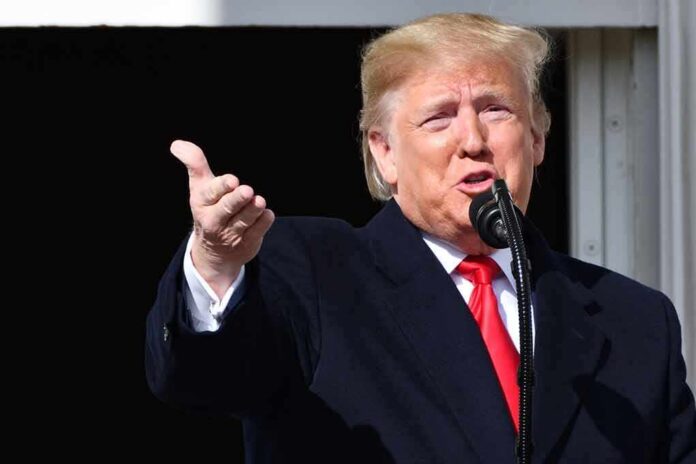
On live television, a CNN anchor pushed health doubts about President Trump—and the Time reporter who just spent days with him said the president is in “great health.”
Story Highlights
- Kasie Hunt raised health and stamina questions about President Trump on CNN.
- Time reporter Eric Cortellessa pushed back, saying Trump has strong stamina and is in “great health.”
- Time’s feature described Trump’s style in the Oval Office but did not claim medical decline.
- Experts warn media health speculation often outruns facts and fuels partisan narratives.
CNN Prompted Health Doubts; Time Reporter Rebutted Them
On October 2, CNN host Kasie Hunt told viewers that “a lot of Democrats” question President Trump’s fitness and asked Time reporter Eric Cortellessa about Trump’s “stamina” after two recent interviews. Hunt also said Trump “seemed to be struggling to hear” a question. Cortellessa did not echo those concerns. He said Trump maintains a very high level of stamina and “works constantly,” a direct on-air rejection of the health insinuation.
Time then published the full exchange and the magazine’s cover story. In the transcript, Cortellessa stated on the record, “I think he’s in great health,” and asked to be quoted, stressing he had observed Trump across two intense days of activity. That is a clear, named assessment from the reporter who was with the president, not an anonymous source or a partisan talking point.
What Time Reported Versus What It Did Not
Time’s feature described Trump’s manner during a seventy-five minute Oval Office interview as “discursive and grievance-fueled.” That line speaks to tone and style, not diagnosis or decline. Style can be debated; health claims require proof. The article did not present medical findings or signs of impairment. The reporter’s own health assessment was positive, and it came after extended, in-person access to the president.
Viewers heard two different messages: CNN flagged concerns, and the journalist with firsthand access dismissed them. For readers who want facts, the on-the-record statement about “great health” carries more weight than a studio prompt framed around partisan chatter. When evidence is thin, media nudges can morph into rumors. Direct observation, attributed by name, is the sturdier standard.
Why Health Speculation Keeps Surfacing
Major outlets repeatedly revisit presidential health because age, viral clips, and limited medical disclosures spark recurring debate. This cycle rewards alarm and reassurance at once, even when hard proof is scarce. International coverage has noted how questions resurface amid images and partial details, then spread through commentary and social media. That pattern can mislead voters if it substitutes vibes for verifiable facts.
Responsible reporting handles two duties at once: do not “diagnose from afar,” and do not hide real information when it exists. That means privileging named sources, official records, and clear timelines over innuendo. In this case, the strongest specific evidence presented to the public was Cortellessa’s direct statement that Trump is in great health after close, recent contact. That outweighs a host’s broad prompt about what “a lot of Democrats” say.
What Conservatives Should Watch For Next
Viewers should separate style critiques from medical claims. A brisk or combative interview is not evidence of illness. If a network raises a health issue, it should be tied to named doctors, medical records, or on-the-record witnesses with close access. Here, the closest witness contradicted the health narrative. That is not a minor point; it is the core of the story, and it undercuts efforts to paint routine moments as signs of decline.
Excellent piece by @katie_keith that raises a ton of questions about the Trump administration's cancellation of ACA coverage for 760,000 people.
Administration Cancels Coverage For More Than 760,000, Blocks New Agents And Brokers | Health Affairs https://t.co/6o0IKP2Wl0— Harris Meyer (@Meyer_HM) October 3, 2026
Americans expect fairness and common sense. Health is serious. It should never be used as a political shortcut to smear an opponent or to distract from policy debates on the border, inflation, crime, and faith and family issues. Demand receipts, not rumors. When the facts land, report them cleanly. Until then, trust the record that names names, cites times, and stands behind clear statements—like the one saying the president is in “great health” after days of direct observation.
Sources:
twitchy.com, transcripts.cnn.com, cnn.com, trump-archive.com