

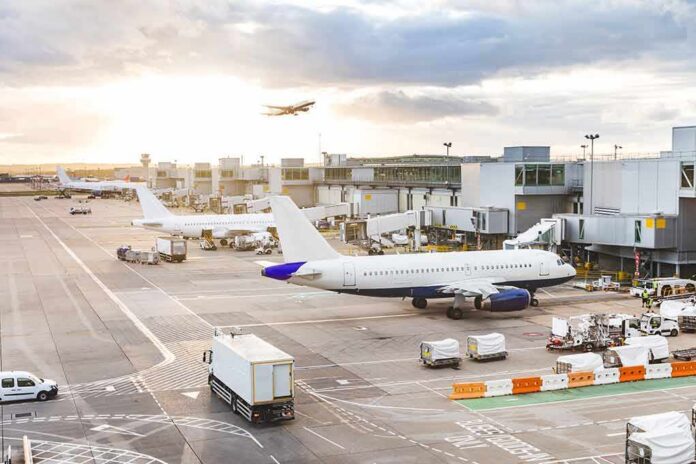
A fresh software fault inside Britain’s air traffic control again stalled flights nationwide, underscoring how one tiny glitch can snarl an entire country’s skies.
Story Highlights
- United Kingdom air traffic control reported a technical issue that disrupted departures across major airports.
- The operator said the fault sat inside flight data processing software and has been mitigated.
- Airports warned of ongoing delays as planes and crews reposition after cancellations.
- Officials ruled out a cyber attack in public comments and pledged a full review.
Confirmed System Fault Triggered UK-Wide Flight Disruption
National Air Traffic Services, the United Kingdom’s air traffic control operator, reported a technical issue that disrupted departing flights across the country. The company said the fault affected a part of its flight data processing system and later confirmed normal operations resumed after engineers implemented a mitigation. Reuters reported the operator traced the problem to a small subsection of software code, and that a permanent fix would be tested and deployed to lock in stability.
Major hubs including London Heathrow alerted travelers to delays and cancellations linked to the air traffic control issue. Airport statements said teams worked with controllers to resolve the problem and asked passengers to check with their airlines before heading to terminals. After service was restored, airports still warned of knock-on impacts as airlines repositioned aircraft and crews to cover stranded routes and out-of-place planes.
Operator Details, Government Pressure, and Cyber Ruling
National Air Traffic Services stated the glitch was inside its flight processing software and confirmed engineers were on site during the event. The operator said recovery took longer than hoped, but that the system was back to normal by early evening local time. United Kingdom authorities gave the provider a short window to produce an initial report on the disruption and define next steps to prevent a repeat. The operator publicly ruled out a cyber attack during media interviews following the incident.
The disruption marked another high-profile hit on a complex system that must run at near-perfect reliability. Media reports placed the event in a pattern of rare but high-impact failures seen in recent years, including a 2023 outage and a radar-related issue in 2025. Those earlier cases triggered widespread delays and cancellations and prompted broader questions about resilience across tightly linked airspace networks.
Why a Small Software Error Can Cause a Big National Mess
Aviation control depends on real-time data, strict safety rules, and precise sequencing. A small coding defect can ripple fast when many flights rely on the same data flow. That “small cause, large impact” effect means even a brief fault can create hours or days of schedule damage as aircraft and crews fall out of place. Analysts have urged clearer recovery targets so the public can track how fast capacity returns after such faults. Technical reviews in the sector also stress building systems that predict and prevent failures, not just detect them.
Airlines criticise air traffic control as second glitch causes more disruption in UK – EasyJet says the latest incident "once again calls into question the resilience" of the system. Via @BBC:https://t.co/6E4foX9m7q
— 🌊💙 Viking Resistance 💙🌊 (@BlueCrewViking) September 21, 2026
Britain’s air traffic operator, regulators, and airlines will now focus on two goals: lock down the specific software weakness and speed up recovery curves after any future hit. The operator says a mitigation is live while a permanent fix is safety tested. Government leaders demanded a full root-cause review. Airlines pushed for accountability because delays cascade into crews timing out, missed connections, and stranded families. Officials and the operator agree safety comes first, but the public also expects faster, steadier service.
What U.S. Travelers and Taxpayers Should Watch
American readers who fly to or through the United Kingdom should expect lingering schedule changes as carriers rebalance networks. When a control center slows or pauses departures, the shock spreads across time zones and lasts beyond the initial outage. Check flight status early and often, and avoid tight connections through busy hubs. This event also offers a clear lesson at home: invest in resilient, testable systems, demand transparent recovery metrics, and keep accountability high so one millisecond bug does not derail thousands of lives.
Sources:
thegatewaypundit.com, reuters.com, cnbc.com, rediff.com, theguardian.com, thetraveler.org, bbc.com