

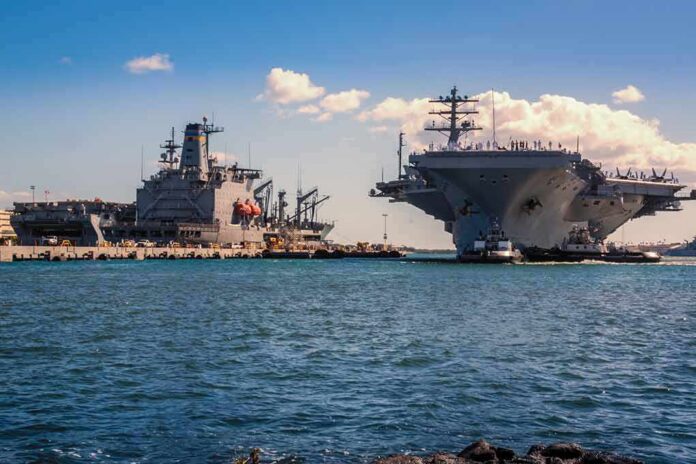
Washington budget officials are quietly pushing special funding carve‑outs that could jump‑start new battleships and carriers even while the rest of the government sits under a spending freeze.
Story Snapshot
- The Office of Management and Budget wants “anomalies” in the next continuing resolution to move Navy shipbuilding faster.
- These exceptions would let the Pentagon lock in big ship and munitions contracts before all designs and details are final.
- Conservatives face a choice: speed up hard power at sea, or guard tightly against special budget workarounds.
- Shipbuilding delays, foreign-yard proposals, and years of bad planning have made the Navy a flashpoint in budget fights.
OMB presses for shipbuilding exceptions in a stopgap budget
The Office of Management and Budget, which manages the federal purse, is backing special exceptions inside the next continuing resolution so the Navy can push ahead on major warships and munitions even while Congress has not finished normal annual spending bills. Under standard rules, a continuing resolution keeps funding stuck at last year’s levels and blocks new contracts unless Congress writes in specific changes. OMB’s move uses a long‑standing tool called an “anomaly” to break that logjam for selected programs.
White House budget guidance says that when a Treasury Account Fund Symbol needs more money than the automatic amount allowed under a continuing resolution, the agency must either live with the cap or ask OMB for a special exception apportionment. An enacted “spend‑faster anomaly” lets the agency skip that case‑by‑case process and move funds for the named program more quickly. In practice, that means big-ticket shipbuilding lines or missile buys can get fresh cash now instead of waiting months for a full-year appropriations law.
Why battleships, carriers, and submarines are stuck in a funding squeeze
Shipbuilding suffers more than most parts of the military when Washington runs on stopgap bills because warships take years to plan and build and depend on advance procurement and multi‑year contracts. Defense experts note that full funding rules normally require all money for a ship before the Navy signs a construction contract, but Congress has carved out tools like incremental funding and block buys for vessels with long lead times. When a continuing resolution keeps new starts on hold, second‑line submarines, carrier overhauls, and escort ships slip behind schedule, giving China and other rivals more time to widen the gap at sea.
Recent laws such as the “One Big Beautiful Bill Act” already poured about $29 billion into shipbuilding and the maritime industrial base, with clear goals to fix late programs and weak yard capacity. That act also created a new Office of Maritime and Industrial Capacity inside the White House to keep pressure on the defense shipbuilding base. OMB’s current push for anomalies fits into that larger Trump‑era strategy: get steel cut, keep workers on the job, and prevent American yards from sitting idle while Congress argues over topline spending.
Trump budget team ties fast funding to accountability and foreign options
Inside this broader fight, OMB leaders under President Trump have signaled they will not simply write blank checks; they want results from shipbuilders. In a major industry speech, the OMB director warned Navy contractors to deliver on time and on budget or risk losing work to other yards. That tough message dovetails with new funding pushes, including a separate reconciliation request that could steer about $1.85 billion into research and possible procurement of warships built initially in allied foreign yards like Japan or South Korea.
That foreign‑yard idea would need legal changes or waivers because current United States Code limits building combat vessels for the armed forces in foreign shipyards. A draft proposal from Senator Mike Lee shows one path, creating a narrow exception for construction of naval vessels in certain allied countries under set conditions. OMB officials have argued that bringing in temporary foreign production, then forcing those companies to build new facilities on American soil, could add capacity and competition to the domestic base. Conservative voters will likely weigh that promise of more ships against the instinct to keep warship construction firmly on United States ground.
Balancing fast-tracked shipbuilding with constitutional and fiscal guardrails
For constitutional and budget hawks, OMB’s anomaly plan raises a key question: how far should the executive branch stretch special tools inside continuing resolutions before it starts to erode Congress’s core power of the purse. Each anomaly carves a small tunnel through the normal wall that keeps agencies at last year’s levels, and too many tunnels can begin to look like back‑door appropriations. Fiscal guidance from past administrations stresses that authority to obligate funds in advance of appropriations is supposed to be rare and clearly grounded in statute.
At the same time, defense‑focused conservatives see real risks in letting shipbuilding stall. Congress has already admitted that earlier Navy budgets fell short and needed extra billions for destroyers, submarines, and amphibious warships. The Trump defense law and follow‑on bills aim to restore hard power without repeating the waste and drifting priorities of past “globalist” years. The coming continuing resolution debate will show whether Republicans in Congress back OMB’s use of anomalies to speed battleship and carrier work, or tighten the reins to reassert traditional, line‑by‑line control over every dollar.
Sources:
realcleardefense.com, whitehouse.gov, federalbudgetiq.com, everycrsreport.com, law.cornell.edu, manufacturingdive.com, breakingdefense.com, uscode.house.gov, news.usni.org, lee.senate.gov, ndtahq.com, congress.gov, idga.org