

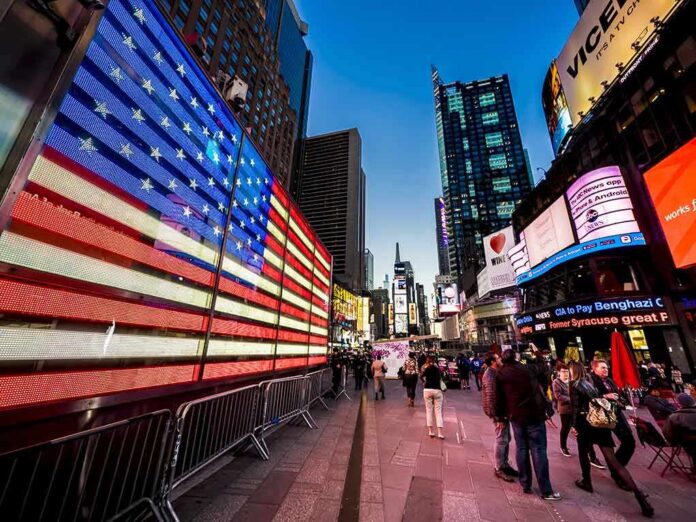
The first-ever July Times Square Ball drops are being billed as a “shared national moment,” yet most Americans can only watch from the outside.
Story Snapshot
- The Times Square Ball is dropping eight times on July 3, 2026, to mark midnight in every American time zone.
- This is the first time in the 118-year history of the ball that it is used outside New Year’s Eve.
- The celebration is run by a congressionally approved Semiquincentennial group and backed by major corporate partners.
- The “national moment” is a closed-set broadcast with limited tickets, raising questions about access and elitism.
A Historic First That Most Americans Only See Through a Screen
Organizers with America250, the body Congress picked to oversee the 250th birthday celebrations, set up a massive show in Times Square for July 3, 2026. The Times Square Ball is scheduled to drop eight separate times, marking midnight in every American time zone from Guam all the way to American Samoa. This marks the first use of the famous ball outside of New Year’s Eve in more than a century of tradition. It is being sold as a once‑in‑a‑lifetime national moment that kicks off Independence Day.
The schedule turns the New Year’s ritual into a full‑day media event. America250’s own materials say the first drop happens at 10 a.m. Eastern for Guam, with the “main” New York City countdown at 11:59 p.m. Eastern to mark the arrival of July 4 on the East Coast. The final drop is planned for 7 a.m. Eastern to line up with midnight in American Samoa. This rolling set of countdowns is designed as a TV and streaming showcase rather than an open street party.
The Constellation Ball and a Congress-Backed Anniversary Machine
The ball doing all this work is the new “Constellation Ball,” the ninth version of the Times Square Ball since 1907. Reports describe it as 12.5 feet across and weighing 12,350 pounds, covered with 5,280 Waterford Crystal circles lit by matching LED pucks. America250 calls this year‑long partnership a way to “unite the entire country” and launch its Giving 4th charitable push, which aims to turn July 4, 2026, into the biggest single day of giving in American history. The group itself was set up and authorized by Congress as the official Semiquincentennial organizer.
Corporate partners play a major role in the production. Coverage notes companies like Coca‑Cola and Major League Baseball tied into volunteer hours, branding, and airtime around the celebration. This pattern matches earlier anniversary fights, where national milestones blend patriotism with heavy corporate marketing. Supporters say big brands bring money and reach. Skeptics see another polished show where ordinary citizens become spectators while sponsors and political appointees control the message.
Closed-Set “National Moment” and Confusing Claims About Public Access
Despite all the talk of unity, official America250 posts say the Times Square event itself is a closed‑set broadcast, not a public street gathering. They state clearly there will be no public viewing areas in Times Square and describe a “limited, ticketed experience” inside One Times Square. Local TV coverage notes that ticket details for this inside access have not been released, leaving everyday New Yorkers and visiting families in the dark about who can actually be there and how they qualify. For now, most Americans are told to watch from home as audiences, not participants.
At the same time, at least one lifestyle site advertises the ball drop as “free and open to the public,” clashing directly with what America250 itself says. That mix of messages can easily breed distrust. People may make travel plans expecting an open Times Square party, only to find barricades and cameras instead. For a celebration that claims it wants every American to “see themselves in this moment,” unclear and shifting rules about access undercut the promise and feed frustration about insiders versus the rest of the country.
Tradition, Patriotism, and the Risk of Over-Managed Celebrations
The Times Square Ball has signaled the New Year since the early 1900s, when owner Adolph Ochs first dropped an iron ball to replace banned fireworks. That tradition has survived wars, blackouts, and culture changes, becoming one of the most watched countdowns on earth. Moving the ball into July for a government‑sanctioned anniversary show is a major symbolic shift. It ties a private building and a media ritual directly into official national observance, which some conservatives see as mixing state‑approved messaging with what used to be a simple civic party.
The centerpiece of the annual Times Square NYE celebration, the Constellation Ball, will be lit up and dropped 8 times on July 3 for America's 250th. https://t.co/cjZB9iLHbk
— Seacoastonline.com (@seacoastonline) July 3, 2026
The bigger question is who these shows are really for. America250 leaders talk about “all 350 million Americans” joining a single shared experience. Yet the key moments are locked inside a closed production, run by a commission and sponsors, with the public invited mainly as viewers. For many on the right who value bottom‑up patriotism—local parades, church cookouts, town fireworks—that feels backwards. Americans do not need a tightly scripted, corporate‑branded ball drop to remember why July 4 matters. They need leaders who trust citizens, protect their freedoms, and let real communities, not media producers, lead the celebration.
Sources:
instagram.com, fox5ny.com, facebook.com, america250.org, nj.com, balldrop.com, timessquareball.net