
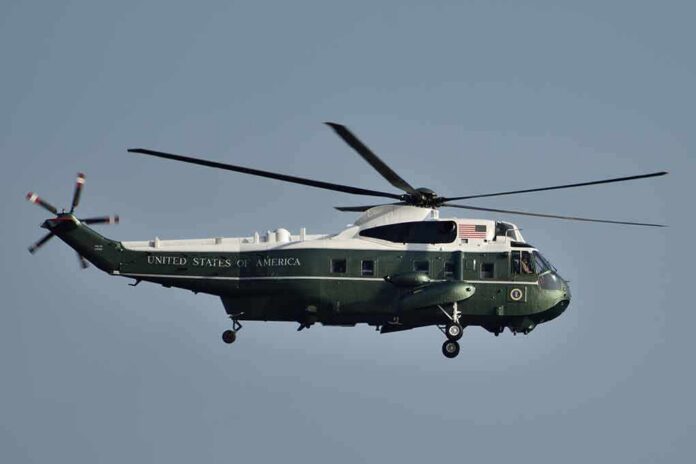
A radio blind spot near the White House let Marine One lose contact with air traffic control, forcing urgent fixes to protect the president and the flying public.
Story Highlights
- Investigators say controllers did not hear Marine One’s required call before liftoff.
- Technicians traced the issue to poor line-of-sight radio coverage near the Ellipse.
- Federal Aviation Administration officials moved an antenna and changed procedures.
- Temporary White House construction and a shifted takeoff spot added risk.
What Investigators Found About The Lost Radio Calls
Federal investigators reported that air traffic controllers in Washington, D.C., did not hear Marine One’s three-minute departure warning on August 4, 2026. The Marine Corps crew tried to pass the message through Joint Base Anacostia–Bolling, but the relay failed. That left tower controllers without the standard heads-up as the presidential helicopter lifted off in busy airspace. The National Transportation Safety Board’s preliminary reporting outlined the missed calls and the crew’s unsuccessful workaround effort.
The reporting also noted that the Marine One movement occurred as a commercial jet was departing Ronald Reagan Washington National Airport. While separation standards were met, investigators tied the communication breakdown to a riskier setup than normal. The breakdown mattered because, in crowded terminal airspace, quick and clear radio calls help controllers time departures and arrivals. Without that warning, managing traffic gets harder, and small timing shifts can stack risk in seconds.
Why The Radios Failed: Line-Of-Sight And A Changed Launch Point
Federal Aviation Administration technicians traced the problem to basic physics: line-of-sight radio coverage did not reach Marine One’s temporary launch spot on the Ellipse. Structures between the helicopter and the receiving site blocked the signal. Aviation manuals and studies have long warned that very high frequency communications need a clear path, and low-altitude helicopters are the most vulnerable when buildings or terrain get in the way. That is what happened here, according to the early findings.
Investigators and press reports added that construction at the White House pushed Marine One to use a different takeoff location than usual. That shift changed the angle to the airport’s remote antennas and worsened the shadowed area. When geometry changes, even a few hundred yards can make a strong signal drop to nothing. The National Transportation Safety Board said the temporary relocation due to construction was a factor in the incident, compounding the line-of-sight problem.
What Got Fixed: Hardware Moves And Procedure Changes
After the incident, the Federal Aviation Administration moved a key antenna serving the airport and updated controller procedures to prevent a repeat. The agency’s chief said the antenna relocation and procedural tweaks were completed quickly. The goal was simple: give controllers a clean link to Marine One from engine start through climb-out, even if the helicopter uses a temporary pad again. Moving hardware is a basic fix, but it often solves these shadow problems at once.
Additional reporting said federal officials planned stronger radio coverage, refined steps for controller-pilot coordination, and extra training tied to these scenarios. These actions aim to remove single points of failure and ensure backups work when one site cannot hear the aircraft. The approach matches common-sense risk control: improve the signal, tighten the playbook, and rehearse it. That tempo respects safety and accountability, which readers expect around the commander in chief.
Safety Context In A Tight And Busy Sky
Washington’s airspace is complex and crowded. When radio coverage is weak at low altitude, small gaps can create big headaches for towers and pilots. Federal guidance reminds operators to confirm they are within range of a ground station because some remote sites do not transmit and receive on all frequencies. That means you can sometimes hear the tower, but the tower cannot hear you unless the aircraft is in a clean line-of-sight pocket. That mismatch showed up in this case.
🔴 Marine One loses radio contact with air traffic control again, second incident in month
President Trump's helicopter experienced communications failure with air traffic controllers on Thursday as it prepared for takeoff from Washington, D.C., requiring intervention from… pic.twitter.com/oa0pIyblLX
— NewsTongue (@NewsTongueX) August 28, 2026
Regulators also tightened helicopter-airplane coordination after a deadly crash in 2025. Those policy changes raised the bar for separation and shifted away from visual see-and-avoid in busy areas. Against that backdrop, the Marine One radio failure stood out. The fix—moving an antenna and updating steps—fits a pattern investigators favor when technology and terrain, not pilot error, drive risk. It is the practical answer our readers want: identify the bottleneck, fix the hardware, and demand disciplined execution.
Sources:
cbsnews.com, scrippsnews.com, aerotime.aero, reuters.com, wsj.com, newsnationnow.com, apps.dtic.mil, skybrary.aero