

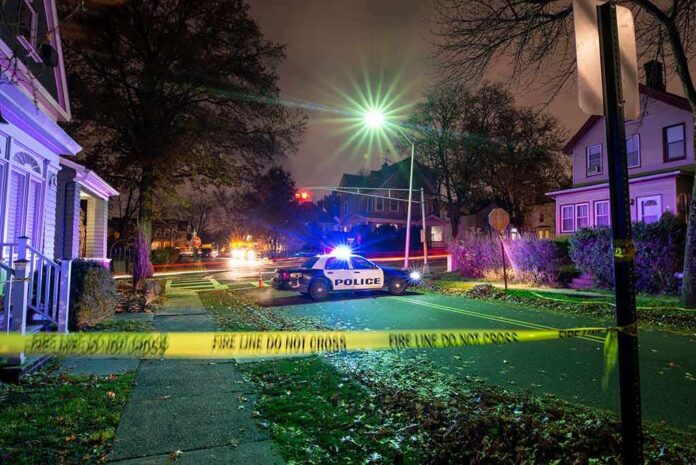
A quiet Iowa river town has been shattered after police say a man gunned down six of his own relatives at three homes before turning the weapon on himself.
Story Snapshot
- Police in Muscatine, Iowa, say 52-year-old Ryan Willis McFarland killed six family members at three locations before dying by suicide during contact with officers.[1][2]
- Four victims were found shot to death inside a Park Avenue home, with two more male victims discovered at separate addresses across town.[1][2]
- Authorities describe the massacre as a domestic dispute and insist there is no ongoing threat, even as basic records about the case remain sealed.[1][2]
- The tragedy highlights a growing pattern of family mass killings while raising fresh questions about mental health, early warning signs, and how quickly official narratives harden into “facts.”[1]
What Police Say Happened In Muscatine
Muscatine police say the horror began at a home on 210 Park Avenue, where officers responding to a call discovered four people dead from gunshot wounds inside the residence.[1][2] Investigators quickly tied that scene to two more shootings across town, locating one male victim at 1509 Mill Street and another male victim at 808 Grandview Avenue, both dead from gunfire and linked to the same suspect.[1] Officials publicly framed the case as a single domestic incident rather than random street violence.[1][2]
Authorities identified the suspect as 52-year-old Ryan Willis McFarland, a Muscatine man whom they say fled the initial scene before officers tracked him toward a riverfront trail near a pedestrian bridge.[1][2] During contact with police near that bridge, officials say McFarland died by suicide, bringing the total death toll to seven, including the alleged gunman.[1] Police emphasized that, with the suspect dead, there was no continuing threat to the broader community and no indication of a wider plot.[1][2]
A Family Massacre And An Ongoing Investigation
Investigators say all six victims are believed to be family members of McFarland and that the entire rampage grew out of a domestic dispute that spiraled into lethal violence across multiple addresses.[1][2] That key detail—family ties—remains framed as a belief rather than a fully documented fact, because police have not yet released kinship records or autopsy findings to the public.[1][2] Multiple news outlets repeat the family connection, but they rely on briefings, not underlying court or medical documents.[1][2]
Local officials named the Muscatine Police Department as the lead agency, supported by the Muscatine Fire Department, the county sheriff, the Iowa State Patrol, and the Iowa Division of Criminal Investigations.[1][2] Lieutenant David O’Connor of the Major Crimes Unit was publicly listed as the point of contact, underscoring that this is an active, multi-agency investigation, not just a media storyline.[1] Even so, authorities have not yet shared incident reports, emergency call logs, or ballistic analyses that would answer deeper questions about timeline, weapons used, or prior warnings.[1][2]
Gaps, Hard Questions, And A Conservative Lens
Across broadcasts, reporters and anchors generally accept law enforcement’s early account, repeating that McFarland shot six relatives and then himself during a confrontation with officers near the river.[1][2] Some transcripts even disagree on the spelling of his last name and the exact date, showing how fast-cycle coverage can introduce confusion while still hardening an official story in the public mind.[1] Without coroner reports or full investigative files, the public is asked to trust conclusions that have not yet been independently verified.[1][2]
A mass shooting occurred in Muscatine, Iowa, leaving seven people dead, including the suspected gunman. Police believe the victims may have been members of the same family. pic.twitter.com/8FGzQgyvfa
— Dyonne (@kgpnet) June 2, 2026
For conservatives who value family, personal responsibility, and government transparency, this case raises two parallel concerns. First, domestic mass killings like this follow a grim pattern seen in other family massacres, where serious stress, isolation, or untreated mental illness erupts into lethal violence behind closed doors.[1] Second, crucial information about what warning signs were missed—and whether any system failures played a role—often stays buried in sealed reports long after the cameras leave.[1][2]
Why This Tragedy Matters Beyond One Town
Researchers who study family mass murders note that these crimes happen mostly in private homes, often with the killer closely related to every victim and sometimes with little prior criminal history.[1] That pattern raises hard questions about cultural and policy choices: whether communities still have the moral and social backbone to intervene early, whether prosecutors and judges are strict enough on known threats, and whether public safety systems are prioritizing families over politics and public-relations talking points.[1][2]
While Muscatine authorities insist there is no remaining threat, they have not yet explained what support, if any, was offered to this family beforehand, what firearm history may have existed, or how many calls for service were previously made to these addresses.[1][2] Until basic records like autopsy findings, incident reports, and forensic reconstructions are released, grieving residents and a watching nation are left with a brief official summary and few tools to demand accountability, learn lessons, or craft policies that strengthen families and protect innocent life.[1][2]
Sources:
[1] Web – Iowa Gunman Kills 6 Family Members Before Shooting Himself: Police
[2] Web – Watch Family Massacre: Season 1 Free | Fandango at Home (Vudu)