
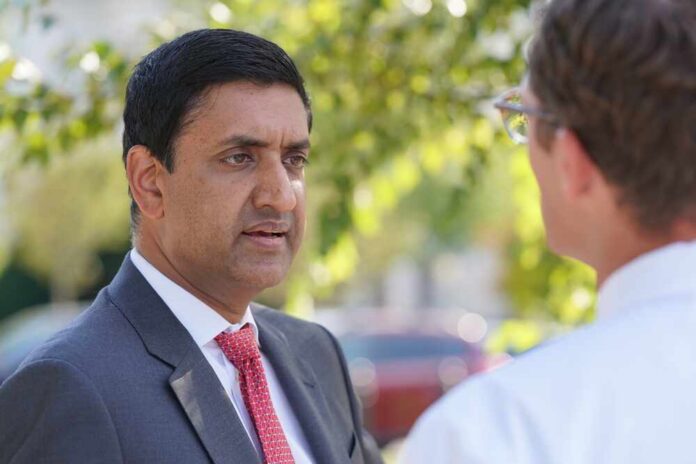
Rep. Ro Khanna openly admitted that the wealth tax he champions must not stop at billionaires — and that $50 million in personal wealth should be the next target.
Story Snapshot
- Khanna and Sen. Bernie Sanders introduced the “Make Billionaires Pay Their Fair Share Act,” a 5% annual wealth tax on America’s 938 billionaires.
- Khanna himself said the tax “must not stop at billionaires” — pointing to a $50 million threshold as the next step.
- Economists and the Cato Institute warn the tax would raise far less than promised, and could trigger a mass exodus of wealthy job creators.
- Khanna is personally worth an estimated $200 million or more, drawing sharp criticism that he won’t voluntarily pay the tax he demands of others.
The Proposal: Tax Billionaires First, Then Everyone Else
Rep. Ro Khanna (D-CA) and Sen. Bernie Sanders introduced the “Make Billionaires Pay Their Fair Share Act” in early 2025. The bill would impose a 5% annual wealth tax on the roughly 938 U.S. billionaires, whose combined wealth totals about $8.2 trillion. Supporters claim it would raise $4.4 trillion over ten years. But Khanna went further — saying publicly the tax “must not stop at billionaires” and that households worth $50 million should be next.
The bill’s spending list is massive. It would reverse over $1 trillion in Medicaid and Affordable Care Act cuts, expand Medicare, build 7 million affordable homes, and cap childcare costs at 7% of family income. It also includes a $3,000 direct payment to every American earning under $150,000 in the first year. That’s a lot of promises riding on projections that independent experts already say are wildly overstated.
The Numbers Don’t Add Up
The Cato Institute reviewed the Sanders-Khanna revenue claims and found serious problems. After accounting for how people actually respond to new taxes — moving assets, changing behavior, or leaving the country — analysts estimate the tax would raise closer to $2.3 trillion, not $4.4 trillion. That’s about half of what lawmakers claim. The Hoover Institution found the same pattern with California’s version of the tax, estimating it would raise 60% less than advertised.
Even if the full $4.4 trillion came in, it still wouldn’t fix the federal deficit. The U.S. deficit is on track to hit $2 to $3 trillion per year by 2036. A full decade of wealth-tax revenue would barely cover one year of that gap. The Cato Institute put it plainly: even the most aggressive “tax the rich” plans are not serious tools for fixing the nation’s finances. The math simply doesn’t work.
Hypocrisy Watch: Khanna’s Own Fortune
Khanna is not a poor man standing up for the working class. His family’s net worth is estimated at around $200 million, with reports of $53 million in personal trading volume. Anti-tax advocate Grover Norquist publicly challenged Khanna to lead by example and voluntarily pay the wealth tax he wants to impose on others. Khanna has not done so. Critics note the contrast is hard to ignore — a multimillionaire congressman demanding others hand over their wealth.
Bernie Sanders and Ro Khanna just introduced a bill for a 5% annual wealth tax on America's 938 billionaires. It would raise $4.4 TRILLION over a decade. Elon Musk alone would owe $42 billion.
#TaxTheSuperRich #FightInequality
Sign: https://t.co/Ttbw1JIYXG pic.twitter.com/LuJdv0glpr— Shekila.a (@NgangaShekila) July 4, 2026
California is also pushing its own version — Proposition 40, a one-time 5% tax on state billionaires set to appear on the November 2026 ballot. Tech leaders are furious. Executives have threatened to leave the state. The Hoover Institution’s Joshua Rauh warned the departure of wealthy residents could trigger a permanent loss of income tax revenue — a net negative of nearly $25 billion for California. Even Gov. Gavin Newsom, a Democrat, opposes the California version.
The Slippery Slope Is Already Here
Khanna’s own words are the clearest warning. He said the wealth tax must not stop at billionaires — $50 million is the next line. After that, what stops politicians from moving the target to $10 million? Or $1 million? History shows that taxes sold as hitting only “the ultra-rich” almost always expand. The income tax started in 1913 at 1% on the wealthiest Americans. Today, it touches nearly every working adult in the country.
This is not about fairness — it’s about government growth. Progressives want to fund a massive expansion of federal programs by targeting wealth they didn’t create. When the revenue projections fall short, as they always do, the next step is broadening the tax base. Khanna already told you that’s the plan. Conservatives should take him at his word.
Sources:
khanna.house.gov, cnbc.com, linkedin.com, nytimes.com, itep.org