
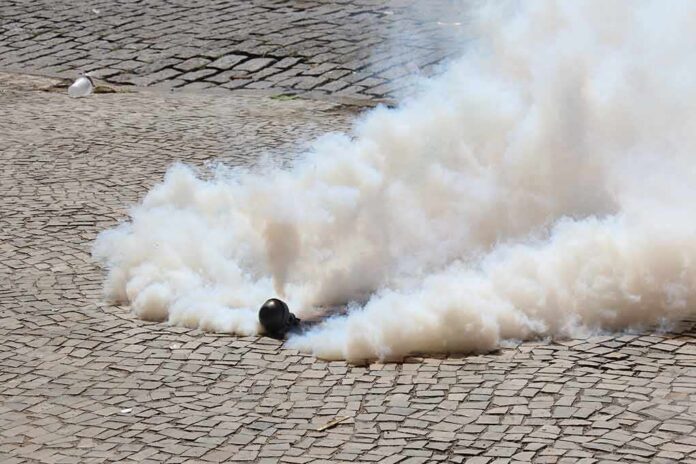
Italian police used water cannons and tear gas to push back a student crowd at Turin’s Piazza Castello, forcing demonstrators away from the Prefecture during a tense march.
Story Highlights
- Police activated water cannons in front of the Prefecture at Piazza Castello in Turin.
- Reports describe tear gas and limited police charges after objects were thrown.
- About 1,000 students marched through the city before the clash near the Prefecture.
- Media noted arrests of minors and dozens of identifications tied to the unrest.
Police Deploy Water Cannons and Tear Gas at Piazza Castello
Italian outlets reported that police turned on water cannons at Piazza Castello, directly in front of the Prefecture, during a student demonstration on October 16, 2026. The cannon blasts drove protesters away from the government building and toward nearby streets. Rai and local press said officers also used tear gas during the operation. The outlets framed the measures as part of crowd control at a sensitive site that houses key state offices.
Coverage from national and local papers stated that tensions rose as a group approached the police line guarding the Prefecture. Reports said some in the crowd hurled stones and bottles, and that officers responded with the water cannon and tear gas. One account described the stream pushing participants from the square toward Via Po, which helped clear space around the building and separate the front ranks from the larger group behind them.
Large Student March Reaches a Sensitive Government Site
Rai reported that roughly 1,000 students moved through central Turin earlier in the day before reaching Piazza Castello. The march was part of a broader wave of school and climate demonstrations across Italy, and some participants split off near the square. Outlets described a subgroup, including some with covered faces, pushing closer to the officers. At that point, the police water cannon and gas were deployed to hold the line at the Prefecture.
Accounts from multiple outlets noted additional crowd-control steps tied to the dispersal. La Repubblica described protesters resisting the water blasts and then edging forward again, after which police performed limited charges to regain space. Another outlet said officers repeated the water-cannon use and released tear gas to break up tight clusters near the police shield line. These actions were reported as focused on the area closest to the Prefecture threshold.
Arrests, Identifications, and What Is Confirmed So Far
Italian media cited police sources who reported arrests of three minors and the identification of dozens of young people following the clashes. The same reports did not present detailed charging documents or medical totals linked to the water-cannon bursts, tear gas, or brief charges. The figures align with standard post-incident steps after public-order operations, but complete injury counts and legal filings were not detailed in the initial news cycle.
While the outlets differed on the exact moment the clash peaked, they agreed on the core facts: police guarded the Prefecture, a subgroup pressed forward, some threw objects, and water cannons and tear gas were used to push the crowd back. The scene fits a pattern seen in Italy when crowds test a police line at government buildings. Similar tactics appeared in Rome during protests in 2021, when officers used water cannons and gas to control access near key state sites.
Why This Matters to Public Order and Free Assembly
European court guidance holds that policing of assemblies must be necessary and proportionate, with targeted force that protects life and allows peaceful expression where possible. The Turin reports focus on the immediate security need around the Prefecture, alongside claims of projectiles from a subgroup. That framing places the event in a public-order context, where water cannons and gas are used to prevent a breach at sensitive state buildings while dispersing small, aggressive elements.
🇮🇹 POLICE DEPLOY TEAR GAS AND WATER CANNONS TO DISPERSE STUDENT PROTESTERS IN TURIN, ITALY pic.twitter.com/uFekiKgNjj
— Aerion Reporters (@Aerionreporter) October 16, 2026
The day’s events also show how small groups can redirect a larger protest. A march about schools and climate drew many peaceful students, but the confrontation centered on the Prefecture line. Police moved to hold that line and clear the square. For citizens, the lesson is simple: large crowds near government buildings can turn fast, and officers will act to keep distance and stop objects from striking the shield line when a subgroup escalates.
Sources:
youtube.com, torino.corriere.it, lastampa.it, video.corriere.it, rainews.it, echr.coe.int, reuters.com