

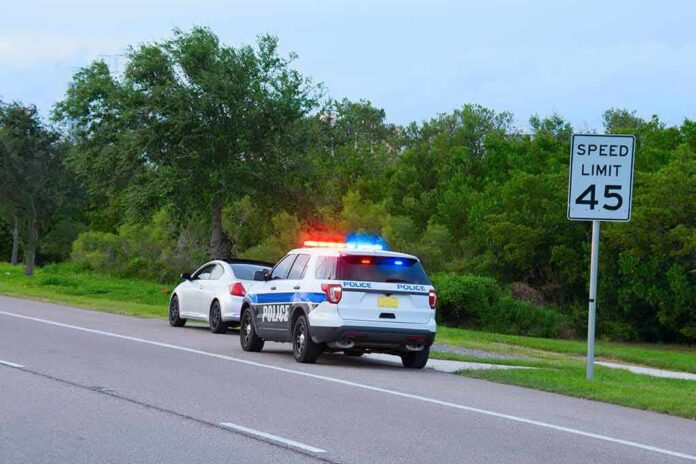
The most revealing part of this story is not that a deputy ticketed a woman for using a hand she does not have, but how one ten‑minute stop exposes the gap between common sense, modern policing, and the letter of the law.
Story Snapshot
- A Palm Beach County deputy insisted he saw a disabled driver holding a phone in her missing right hand.
- Bodycam video, later released, shows the driver calmly proving she has no right hand.
- The citation for “wireless communication device/handheld while driving” was later dismissed at the deputy’s request.
- The case highlights how vague phone laws and rushed enforcement collide with disability, due process, and public trust.
How A Routine Traffic Operation Turned Into A National Story
Palm Beach County deputies were running a distracted driving operation along North Dixie Highway in Lake Worth Beach, Florida, when 36‑year‑old Kathleen “Katie” Thomas drove past in February.[3] The deputy later says on bodycam, “You drove past me holding the phone with your right hand, manipulating that phone … I saw you with the phone.”[5] That one sentence, delivered with absolute confidence, is what detonated the controversy when the footage hit the internet.
Thomas was born without a right hand, something that is obvious the moment she raises her right arm during the stop.[3][6] When the deputy accuses her, she immediately pushes back and shows him the limb difference, effectively demonstrating that the literal act he claims to have observed could not have happened.[3] Viewers do not need law school to follow the logic. A specific allegation collides with visible reality, and the camera captures every awkward second of it.
The Legal Charge That Never Fit The Facts
The deputy still issues a $116 civil citation, marking the offense as “Wireless Comm. Device/Handheld While Driving – First Offense” under Florida Statute 316.305(3)(a).[2][3] That statute, Florida’s Wireless Communications While Driving Law, targets drivers who manually type or enter letters, numbers, or symbols into a wireless device for non‑voice communication while operating a vehicle.[2] Texting, emailing, and instant messaging are the classic examples; the law is aimed at people who are interacting with a screen, not merely existing in the same car as a phone.
Florida attorneys who handle these cases have been blunt about the statute’s limits. Traffic lawyer Michael Donahue says the law explicitly requires manual typing.[2] Another attorney, Ted Hollander, draws the line that matters most here: outside school zones, crossings, and active work zones, “simply holding a phone is not automatically illegal.”[2][3] The citation in Thomas’s case did not indicate a school or construction zone at all, which makes the “handheld while driving” theory look shaky even before you reach the missing‑hand problem.[2][3]
Why The Case Was Dropped And What That Really Means
Court records show the citation was later dismissed at the request of the same Palm Beach County Sheriff’s Office deputy who wrote it.[2][3] Prosecutors canceled the scheduled hearing after the office cited “insufficient evidence.”[2] That phrase is carefully chosen. It stops short of calling the deputy a liar, but it concedes that, once supervisors reviewed the statute and the total circumstances, they could not defend the charge in court. For a civil traffic ticket, that is as close to a retraction as the system usually offers.
Should the Palm Beach County Sheriff's Office deputy be disciplined after giving a ticket to a one-handed woman during a controversial traffic stop?
Vote here: https://t.co/8A50iOIgHc pic.twitter.com/B5fLTDZmsA
— WPEC CBS12 News (@CBS12) May 29, 2026
The agency controls the key documents and video, so outsiders still lack a full internal memo explaining whether the real problem was factual, legal, or both.[2][3] Yet the public does not need a graduate seminar to draw basic conclusions. If holding a phone is generally allowed, if the alleged “right hand” does not exist, and if the deputy himself asks to drop the case, confidence in the underlying accusation erodes. From a common‑sense, conservative perspective, that sequence does not reflect the kind of restrained, accountable government people expect.
Policing, Perception, And Disability In The Age Of Viral Video
This case sits squarely in the new category of high‑salience traffic stops that blow up because they are visually easy to understand.[1][3] The elements are simple: a clear bodycam angle, a claim that can be checked against what viewers see, and a mismatch so obvious that people share it before the lawyers ever speak. The limb difference guarantees that disability advocates will weigh in, but the real gravitational pull is fairness. People want officers to slow down, verify, and correct themselves, not double down on a bad call.
From a rule‑of‑law standpoint, the most troubling part is not that an officer made a fast, possibly mistaken observation in traffic. Humans misperceive. The deeper issue is that the machinery of enforcement—operation, accusation, citation—kept moving even after the driver produced immediate, compelling contrary evidence.[3][5] When an agency later retreats under the label of “insufficient evidence,” it quietly confirms what millions already decided after watching the clip: power moved faster than prudence that day, and the law was not the problem—judgment was.
Sources:
[1] YouTube – US officer accuses disabled driver of holding phone with missing hand
[2] Web – BWC: Fla. deputy cites driver for holding cellphone in hand she didn …
[3] Web – Traffic stop goes viral after Florida deputy accuses driver missing …
[5] YouTube – Viral video shows deputy accusing driver missing right hand of using …
[6] Web – Disabled driver ticketed for using phone shows cop she has no hand