
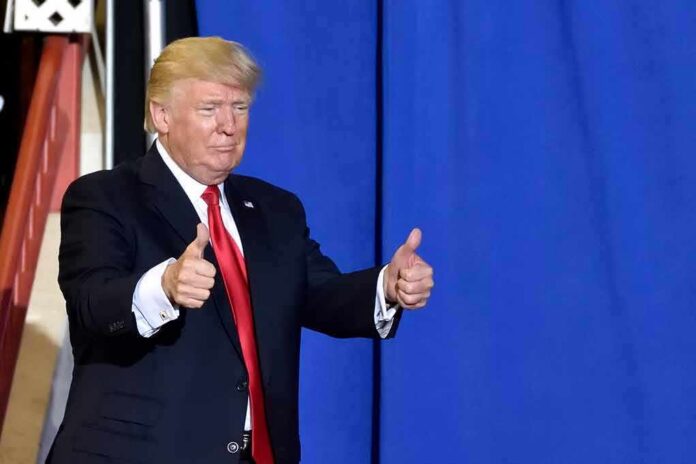
Trump’s name, face, and signature are now on a growing list of federal programs and symbols, from a national park pass to future paper currency, marking a clear break from past presidential practice.
Story Highlights
- Federal agencies are adding President Trump’s name or image to government programs, facilities, and documents.
- Treasury said Trump’s signature will appear on future paper currency, expanding his visible role in daily life.
- Reporters describe the scope as unusual during a presidency, compared with the norm of post-office honors.
- The branding push aims to stamp projects with accountability and a clear policy identity.
What Changed: A Visible Presidential Brand Across Government
News reports detail how President Trump’s name or image is being added to multiple federal touchpoints, including buildings, ships, a drug-price website, and a national recreation pass. The U.S. Department of the Treasury announced in March that Trump’s signature will appear on future paper currency, further expanding his direct imprint on official items Americans use every day. Coverage from across the media landscape frames the scope as broad and coordinated, rather than a series of isolated gestures.
NPR and other outlets say this level of personalization during a sitting presidency departs from long-standing custom, where most naming honors arrive after a president leaves office. Straight Arrow News quoted a historian on legal limits, noting Congress often controls formal renamings, while agencies can set program branding within their lanes. The practical effect is clear labeling of the administration’s priorities. Supporters see sharper ownership and easier public recall of policy goals tied to Trump’s agenda.
Where Voters Will See It: Passes, Programs, Buildings, and Currency
Americans may notice the changes in ordinary settings: a redesigned America the Beautiful recreation pass with Trump’s portrait, signage on select facilities, and presidential branding on a consumer-facing prescription drug website. Future paper currency will bear Trump’s signature, similar to how past Treasury actions placed senior officials’ signatures on notes, but now featuring the sitting president’s own autograph per the department’s announcement. Photos and agency updates have circulated widely as projects roll out on a set timeline.
Media roundups catalog additions across Washington, D.C., and beyond, from cultural institutions to federal buildings and even a class of naval vessels, underscoring how the brand now overlaps with national assets. Reuters described the pattern as atypical, emphasizing the union of a personal brand with public institutions while Trump is in office. For day-to-day users, the experience is practical: the pass still opens gates, the website still lists prices, and the building still serves its mission—with clearer ties to the president who championed it.
Why It Matters: Accountability, Tradition, and Limited Government
Backers argue that naming signals accountability, which many conservatives want from Washington. When a policy succeeds, they say, credit should be plain; when it fails, responsibility should be plain too. A visible brand can help citizens track who promised what. Heritage-minded critics of government bloat also prefer clear ownership over vague, bureaucratic labels that hide who is answerable for outcomes. That view aligns with limited-government thinking and demands for performance over process.
Reporters counter that the breadth and timing break with custom, since most presidents wait until after office for honors that affix their names or likenesses to national fixtures. Straight Arrow News also raised process concerns, pointing out that Congress, not the White House, often decides formal renamings, while agencies maintain discretion inside existing rules. Those cautions focus on preserving checks and balances and keeping civic spaces centered on institutions, not current officeholders.
What Comes Next: Implementation Pace and Guardrails
The pace of rollouts will depend on agency timelines, contracting, and inventory cycles—especially for items like passes and currency that update on schedules. Media lists will likely grow as federal installations change plaques, update digital assets, or complete refits already approved. Agencies will keep operating under their legal authorities and budget limits, while Congress can step in on any area that requires legislation. That mix sets practical guardrails even as branding expands.
My post asks, “So who exactly is the performance for?” The answer may increasingly be: Trump himself.
That doesn’t require assuming mental illness or pretending we know what he privately believes. It’s enough to observe the incentive structure. If acknowledging that Iran retains… https://t.co/WObUTuUV1E
— Andre Robinson MS (@AndreDoctrine) August 18, 2026
For many conservatives, the test is simple: Do these programs deliver? If the drug-price site helps families save on medicine, the label is a feature, not a bug. If a pass boosts park visits and pride in country, the portrait is a plus. Clear names can cut through bureaucratic fog and make Washington answer to the people. The work must stay grounded in the Constitution, respect Congress’s role, and keep faith with the mission of every public institution.
Sources:
theatlantic.com, whitehouse.gov, nbcnews.com