
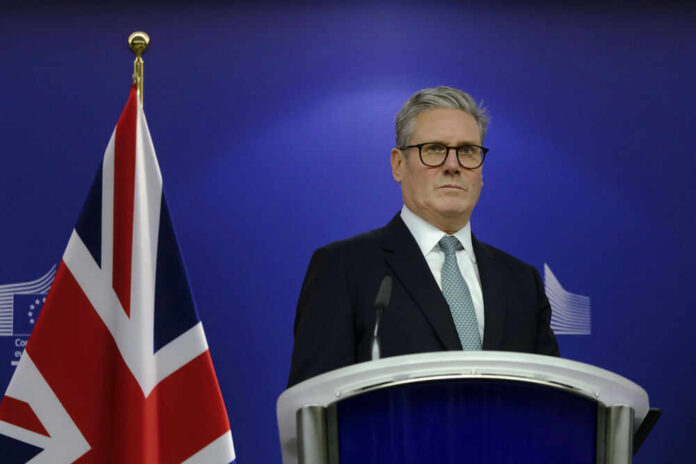
President Trump is openly questioning whether Britain is still America’s “special” ally after Prime Minister Keir Starmer hesitated on Iran—then tried to step in once the hardest part was already done.
Quick Take
- Trump blasted Starmer for initially refusing to join coordinated strikes on Iran and for slow-walking approval for U.S. use of British bases.
- The U.K. shifted within about a day, granting limited base access while still avoiding direct participation in strikes.
- Starmer framed his caution around Iraq-era lessons, insisting on a lawful basis and rejecting “regime change from the skies.”
- Trump’s pressure campaign is now tied to broader burden-sharing, including securing shipping lanes around the Strait of Hormuz.
Trump’s Public Rebuke Tests the “Special Relationship”
President Donald Trump’s criticism of Prime Minister Keir Starmer has turned a behind-the-scenes alliance dispute into a public test of the U.S.-U.K. relationship. After U.S. and Israeli strikes against Iran began on Feb. 28, 2026, the U.K. initially declined to participate. Trump later mocked the U.K. for trying to “join” after the operation was “already won,” signaling that delayed support counts as no support at all.
Trump’s argument is mainly about timing and reliability: if an ally pauses when decisions are urgent, Washington cannot plan around that ally in future crises. The criticism also landed amid reports that the U.K. had considered positioning major naval assets, including an aircraft carrier, at higher readiness. The U.K. government has not presented its posture as offensive participation; instead, it has emphasized restraint and conditional cooperation, including limited support for U.S. basing.
What the U.K. Actually Approved—and What It Refused
The practical dispute centers on operational access. After initially declining to participate in the opening phase of strikes, Starmer’s government reversed course on March 1 by approving limited U.S. use of British military bases. That move reduced immediate friction, but it stopped short of committing British forces to the strike campaign. The U.K. also leaned on narrower deployments, including mine-hunting capabilities, rather than sending a full-scale naval task force.
That middle-ground approach matters because it keeps Britain involved without tying London to the full scope of Washington’s military objectives. For U.S. planners, partial cooperation can still complicate logistics when timelines are tight. For the U.K., partial cooperation limits exposure to escalation and domestic backlash. The result is a partnership that functions tactically in places, but looks strategically uncertain—especially when the American president is publicly tallying who showed up and when.
Starmer’s Iraq-War Warning Collides With Trump’s Burden-Sharing Demands
Starmer’s justification has leaned heavily on legality and lessons from the Iraq War. He has argued that U.K. action must have a lawful basis and a viable plan, and he has rejected the idea of “regime change from the skies.” Those constraints explain why London has emphasized defense, deterrence, and carefully scoped support rather than joining initial strikes. Starmer has also linked de-escalation to lowering cost-of-living pressure at home.
Trump’s framing is different: alliance commitments are not academic seminars, and deterrence fails when adversaries sense hesitation. The underlying disagreement is not whether Iran poses a threat, but how quickly allies should align behind U.S. decisions once conflict begins. Trump has also widened the argument beyond the first wave of strikes, pressing allies on securing energy supply routes and shipping lanes—especially as tensions surrounding the Strait of Hormuz ripple through global markets.
Energy Shock, Domestic Politics, and the Real-World Stakes
The standoff is not happening in a vacuum. Reports have linked the Hormuz disruption and broader conflict fears to energy price volatility, putting governments under pressure to cushion households. Starmer’s government announced heating oil subsidies for 1.5 million households affected by price spikes, underscoring how fast a distant conflict becomes a kitchen-table issue. When leaders are trying to manage inflation and household budgets, foreign policy risk tolerance can shrink quickly.
For American conservatives, the key takeaway is that national security alliances work best when partners are decisive and transparent—not when they calibrate participation for political cover and then expect full credit. At the same time, the reporting available does not establish every operational detail claimed in the political back-and-forth, including how formal any carrier “offer” may have been. What is clear is that Trump is using public pressure to force clarity.
Trump slams Starmer for hesitancy to join Iran war efforthttps://t.co/Pwco5CyFAj
— Human Events (@HumanEvents) March 17, 2026
Looking ahead, the dispute raises a concrete question for NATO: will member states treat U.S.-led action as a shared obligation or as an optional add-on once outcomes look safer? Trump’s warning signals that Washington may plan future operations assuming less European participation unless commitments are immediate. Starmer’s stance signals that Britain wants tighter legal and strategic guardrails before committing force. That gap—more than any single quote—now defines the tension.