

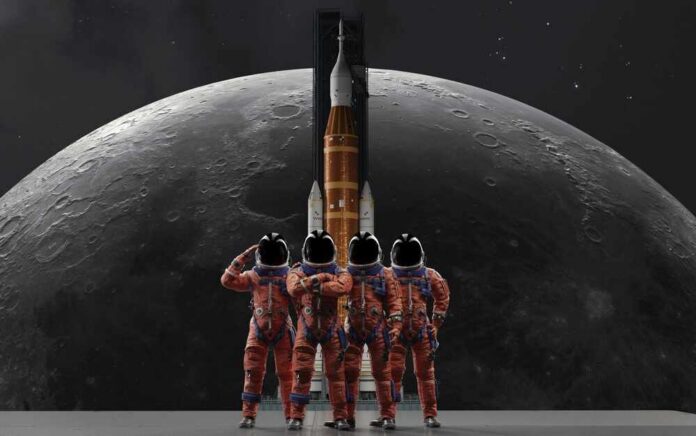
After decades of delays and doubts, America just put astronauts back on a lunar trajectory—proving U.S. deep-space capability is real again, not just a Washington press release.
Quick Take
- Artemis II launched April 1, 2026, sending four astronauts on a 10-day, 695,000-mile trip around the Moon aboard Orion.
- The mission delivered rare images from the Moon’s far side, plus a solar-eclipse view from deep space during the April 6 flyby.
- Orion splashed down safely off San Diego on April 10 and was recovered by the USS John P. Murtha.
- NASA’s photo and video releases are more than public relations: they document test objectives that set the table for Artemis III.
Artemis II’s Timeline Shows a High-Stakes Systems Test That Worked
NASA’s Artemis II mission lifted off April 1, 2026, from Kennedy Space Center’s Launch Complex 39B on the Space Launch System rocket, carrying the Orion spacecraft on its first crewed test flight since the Apollo era. The crew—Reid Wiseman, Victor Glover, Christina Koch, and Canadian astronaut Jeremy Hansen—flew a free-return path around the Moon rather than attempting a landing. That profile kept the focus on life-support, navigation, and deep-space operations.
Christina Koch’s early photography underscored how quickly Artemis II left low-Earth orbit behind, including views of Earth receding on April 2 and later shots of the planet’s day-night boundary. Those images mattered because they visually confirm the mission’s stated trajectory and the spacecraft’s ability to function far beyond the conditions of the International Space Station. In plain terms, Orion wasn’t just “up there”—it was operating where rescue is hard and margins are thin.
The Lunar Flyby Delivered Rare Visual Data—And Proof of Precision
The mission’s centerpiece arrived April 6, when Orion conducted a seven-hour lunar flyby that produced detailed views of cratered terrain, sharp terminator shadows, and far-side perspectives Americans haven’t seen from a crewed spacecraft in generations. NASA began releasing images starting April 7, and later updated some captions for scientific refinement. The agency also described a deep-space solar eclipse view that included the Sun’s corona and even planetary sightings.
Those pictures are not just inspirational; they also help NASA and outside researchers evaluate lighting conditions, navigation geometry, and observational planning for later missions. NASA officials highlighted that the images are intended to inspire, but they also emphasized scientific value tied to lunar geology and surface evolution. That is a practical reminder that “space leadership” is not only a flag-planting contest—it is sustained competence: taking measurements, documenting conditions, and learning what works before the next, riskier step.
Safe Splashdown Closes the Loop—and Shifts Attention to Artemis III
Artemis II returned to Earth on April 10 with a splashdown off San Diego at 8:07 p.m. EDT, followed by recovery operations involving the USS John P. Murtha. A clean ending matters because it validates the full mission chain: launch, deep-space transit, high-speed return, and crew recovery. For taxpayers, that is the difference between a program that merely announces ambition and one that can repeatedly execute complex operations under real-world constraints.
Why This Matters in 2026: Competence, Priorities, and Trust
The Artemis program has a long backstory of development challenges, delays, and cost concerns, which is why a successful crewed flight carries political weight even when the mission itself is not partisan. NASA’s releases emphasize thousands of images and ongoing analysis of craters, lava flows, and fractures, along with operational lessons for future flights. For a public frustrated with federal dysfunction, Artemis II is a rare example of government delivering a visible, measurable outcome—while also raising the inevitable question: can Washington replicate this kind of disciplined execution in everyday domestic governance?
Artemis II Mission Milestones: An Image and Video Recap https://t.co/KGiXNW0jD7 via @NASA
— Lucas Samuel (@LucasSa54749430) April 22, 2026
International participation also shaped the mission’s message, with Jeremy Hansen representing Canada and European technology noted as part of the overall stack. Strategically, that cooperation can broaden support and share expertise, but it also highlights a tension voters across ideologies recognize: national capability still depends on competent institutions at home. Artemis II’s success strengthens U.S. credibility in space at a time of global competition, yet it also reminds Americans that big achievements require focus, accountability, and clear goals—traits citizens often say are missing in routine federal policymaking.
Sources:
https://www.nasa.gov/news-release/nasas-artemis-ii-crew-beams-official-moon-flyby-photos-to-earth/
https://www.nasa.gov/gallery/lunar-flyby/