

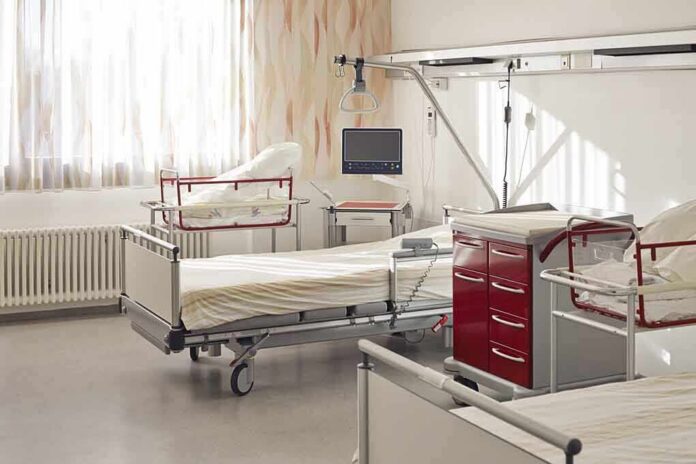
Britain’s National Health Service has ordered hospitals to place patients by biological sex, a clear win for women’s privacy and safety.
Story Highlights
- NHS England says transgender patients should ordinarily be accommodated by biological sex.
- The guidance centers on privacy, dignity, and safety for all patients.
- Clinical exceptions allow alternatives when needed for patient care.
- The policy replaces the 2019 approach and applies across NHS-funded providers.
NHS Sets Biological-Sex Placement as the Default
NHS England published guidance stating that patients with the protected characteristic of gender reassignment should ordinarily be placed according to biological sex. The rule covers wards, bays, and related spaces. Reports quote the operational wording and confirm the new default standard across hospitals in England. This marks a break from years of mixed practice. The move follows public concern about dignity and safety in intimate settings, especially for women on single-sex wards.
The guidance applies to National Health Service trusts, National Health Service foundation trusts, and all providers of National Health Service-funded care. It replaces the 2019 “Delivering same-sex accommodation” document, which leaned on gender presentation and flexible workarounds like curtains or nearby single rooms. National scope means local hospitals should now follow the same rule set. That change aims to end confusion from differing local policies and improve consistent safeguards for patients.
Privacy, Dignity, and Safety Drive the Policy
NHS England titled the document “Privacy, dignity, and safety in hospital accommodation.” The stated goal is respectful care for every patient while protecting boundaries in sensitive spaces. The guidance directs staff to make placement decisions that uphold privacy for all, including vulnerable patients who need calm, secure settings to recover. The focus on dignity pushes back against policies that treated concerns as mere “feelings” rather than basic safeguarding needs in shared bays and bathrooms.
The policy includes a clinical-necessity exception. Hospitals may use alternative arrangements if a placement by biological sex would not be clinically appropriate. Where clinical needs and same-sex accommodation cannot both be met, clinical needs come first. This guardrail prevents rigid placement that could harm care. It also signals that single rooms or other options can be used when needed, while keeping the default guardrails in place for most cases.
What Changed From the 2019 Approach
The 2019 guidance said patients who had undergone transition should be placed by gender presentation. It suggested that privacy could usually be protected by curtains or a side room by a gender-appropriate ward. In practice, trusts adopted varied rules, with some placing patients by self-identified gender. That patchwork frustrated families and staff who saw privacy and safety standards shift from hospital to hospital. The new policy sets a clearer, national baseline that reduces room for local improvisation.
Reporters note that the update aligns with legal developments and revisions by the Equality and Human Rights Commission. Coverage describes a post–Supreme Court reading of sex in the Equality Act that supports single-sex services when tied to a legitimate aim and applied proportionately. That legal footing matters for frontline staff who face complaints or threats of litigation when enforcing boundaries. Clearer national rules help them act with confidence inside the law.
Practical Limits and Open Questions
The available documents do not include outcome data proving that sex-based placement reduces incidents versus other models. There is no national audit yet that tracks safety events or patient-satisfaction changes tied to the new rule. The guidance also leaves details to local judgment when single rooms are scarce or emergency pressures bite. Those gaps mean results will depend on staffing, bed capacity, and how faithfully managers apply the rule and log exceptions.
NHS England has published revised guidance on hospital accommodation, setting out how NHS organisations should meet the NHS Constitution’s pledge on same-sex accommodation.
In response, please read our joint statement with @BritishHIVAssoc ➡️ https://t.co/XQKKAr8eqg (1/2) pic.twitter.com/ykoVpGmbPe
— BASHH (@BASHH_UK) October 20, 2026
Reaction remains polarized. Some clinicians object to the change, while others welcome clarity that “women should not have to share wards with men”. The central fact is settled: placement by biological sex is now the default in England’s hospitals, with clinical exceptions to protect care. For families who value clear boundaries, this is a step toward common sense. Delivery now hinges on firm leadership, honest reporting, and enough single rooms to handle the edge cases.
Sources:
lifesitenews.com, bbc.co.uk, dacbeachcroft.com, lbc.co.uk, uk.news.yahoo.com, whittington.nhs.uk