
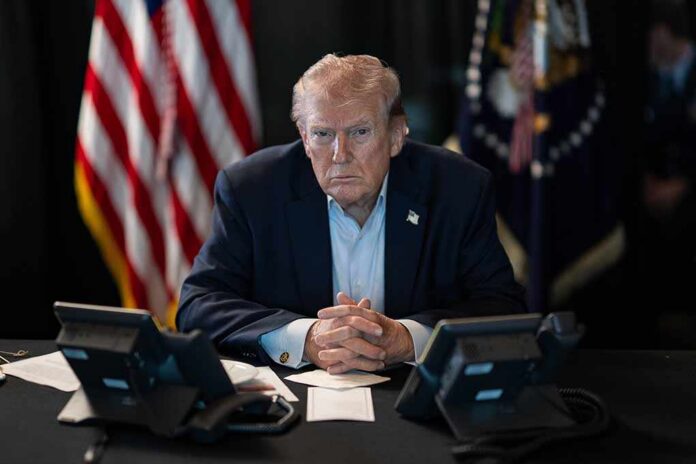
President Trump warned that major outlets that “print lies” about his administration could be sued “into oblivion,” as a federal judge weighs his recent clash with CNN, MS NOW, and Politico over White House access.
Story Highlights
- Trump accused select outlets of “fiction and lies” and signaled sweeping lawsuits.
- Three outlets sued after a White House access ban; a judge later blocked the ban.
- Trump’s separate $10 billion case targets a BBC documentary as defamatory.
- The legal fight spotlights First Amendment limits on restricting press access.
Trump’s Charge: “Fiction and Lies” From Major Outlets
President Trump posted that CNN, MS NOW, and Politico pushed “fiction and lies,” and warned others could be next, according to reports on his September 21 statement. He linked their coverage to harm against his presidency and the public’s trust. His criticism followed the administration’s move to restrict the outlets’ access to White House grounds days earlier. The outlets answered in court and in public statements, rejecting the charge and defending their reporting as fair and accurate.
The White House move sparked a fast legal response. CNN, MS NOW, and Politico sued to regain access, arguing the government cannot punish newsrooms over coverage. Their filings said the credential revocations came without notice or process, and were aimed at silencing reporting about the administration. The case framed the dispute as retaliation that chilled newsgathering protected by the First Amendment, not a routine credential decision.
Courtroom Clash Over Press Access Standards
United States District Judge Timothy J. Kelly later ruled that the ban likely violated the First Amendment and ordered temporary relief while the case proceeds. That ruling emphasized free-speech and due-process protections when the government opens access to the press. The judge’s action did not resolve the truth of any story, but it pressed the administration to follow constitutional standards if it limits access to government spaces used by journalists.
The outlets’ complaint highlighted alleged retaliation and a lack of fair process. It cited case law on credentialing and argued that viewpoint-based exclusions are unlawful. The court’s early ruling aligns with that view for now. The administration can still argue its case on the merits as proceedings continue. For readers, the bottom line is that access limits tied to coverage face heavy legal headwinds in federal court.
Trump’s Separate BBC Defamation Fight
Trump’s legal push also targets the British Broadcasting Corporation. A 33-page complaint seeks $10 billion, saying a documentary titled “Trump: A Second Chance” presented a “false, defamatory” portrait of the President and tried to sway the 2024 election. The Associated Press reported that the case remained in discovery and that British Broadcasting Corporation lawyers sought to compel Trump’s deposition after a schedule dispute. No court finding on defamation has been entered at this stage.
The British Broadcasting Corporation case shows a different legal track from the access fight. Defamation law for public officials is tough. A plaintiff must do more than show a report was wrong. He must prove it was published with knowledge it was false or with reckless disregard. That is a high bar designed to protect debate about government. Trump’s team says the film crossed that line. The court process will test that claim with evidence.
What Conservatives Should Watch Next
Conservatives see a press that often sneers at faith, family, and secure borders. They also know the Constitution guards speech, including reporting they may dislike. The court already flagged problems with how the ban was done. Going forward, the strongest path is targeted accountability. That means tracking specific false statements, demanding corrections, and pressing claims in court with facts and due process, not blanket bans that courts are likely to reject.
Expect more filings, hearings, and discovery. Watch for any list of specific stories that the administration says were false, with evidence to back it up. In the British Broadcasting Corporation case, watch for document production and depositions that test the film’s editing and sources. Wins will come from detailed proof, not broad labels. That approach defends both truth and the First Amendment, while keeping pressure on media that cross clear lines.
Why This Fight Matters for Everyday Americans
Families need facts to judge policies on the border, inflation, energy, and schools. When media report carelessly, trust erodes. When government punishes coverage, liberty erodes. The court’s message is clear: follow the rules, show your work, and keep the forum open. If an outlet defames, sue and prove it. If it reports fairly, let Americans decide. That balance protects our rights while pushing for honest news that serves the people, not the insiders.
Sources:
mediaite.com, cnbc.com, nytimes.com, nbcnews.com, courthousenews.com, washingtonexaminer.com, npr.org, pbs.org, cnn.com, politico.com, bbc.com, transcripts.cnn.com