

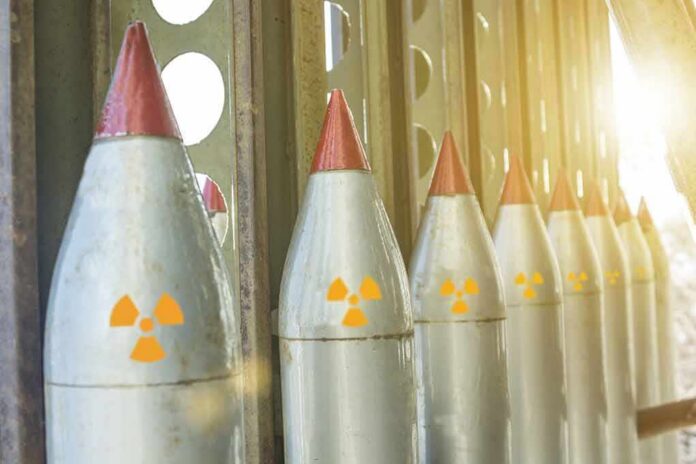
The Navy just moved a low-cost hypersonic missile into production, signaling a major shift toward affordable mass firepower.
Story Highlights
- The Navy issued a production delivery order for the Blackbeard hypersonic missile, advancing it beyond proposals.
- Planned average unit costs for air-launched hypersonics are hundreds of thousands, not tens of millions.
- Castelion targets high-volume output with a new manufacturing campus and private funding.
- Officials are using small business and commercial pathways to speed delivery and cut overhead.
Navy Greenlights Blackbeard Production To Build Cheaper Hypersonic Firepower
The United States Navy announced a Small Business Innovation Research Phase III production delivery order for the Blackbeard hypersonic missile, with a total value of up to $200 million. The Navy said the effort will manufacture, assemble, test, and deliver initial all-up rounds. It called Blackbeard an affordable, rapidly fieldable, and highly survivable long-range strike option. This step moves Blackbeard from pitch to production and backs a push for lower-cost, high-quantity munitions.
Reuters reporting shows the Pentagon’s planning numbers point to a stark price shift. A Navy plan outlines about 4,500 air-launched hypersonic missiles for F/A-18E/F aircraft at an average unit cost near $384,000. That figure undercuts reported price tags for earlier premium hypersonics by orders of magnitude. The goal is simple: arm carriers and air wings with many fast shots instead of a handful of gold-plated missiles that are too scarce to matter in a real fight.
Factories For Scale: Private Money And Faster Contracting
Castelion is building out Project Ranger, a roughly $250 million manufacturing campus the company says can deliver thousands of Blackbeard missiles per year once it is running. That private investment pairs with the Navy’s use of a Phase III contract path meant to skip redundant engineering and speed market entry. The service said this approach can cut millions in non-recurring costs and bring real commercial competition into munitions production lines.
Company leadership has framed the price point in plain terms. Castelion co-founder and chief executive Bryon Hargis said the weapon is under $500,000, which he called “incredibly cheap” for a munition. While company quotes are not audits, the claim aligns with the Navy’s push for affordable mass and with planning figures cited in budget documents. Lower price per shot broadens options for training, deterrence, and fast surge in crisis.
Why Affordable Mass Matters In A High-End Fight
The Pentagon’s broader shift favors large stocks of simple, reliable weapons that can be built fast and used in salvos. Analysts describe this as affordable mass: trading some exquisite features for numbers that can saturate defenses, stress enemy logistics, and keep American pilots in the fight. Parallel efforts seek tens of thousands of cheaper cruise missiles and interceptors to restore depth to magazines across the force, not just on carriers or destroyers.
Government reviews underline why this change is urgent. The Government Accountability Office reports that hypersonic programs face cost and schedule risks due to limited design and production experience. That history helps explain past overruns and thin inventories. Building simpler, lower-cost designs at scale aims to reduce those risks and put real weapons on wings and decks sooner, where they can deter China and any other aggressor eyeing gaps in U.S. stockpiles.
Practical Limits And Next Steps Under President Trump’s Team
Planned quantities and average unit costs are still plans, not delivered inventory. The Navy announcement describes an initial production effort, while Project Ranger must finish construction and ramp hiring and suppliers. Future buys depend on tests, aircraft integration, and appropriations. Those caveats aside, the policy direction is clear: deliver more shots per dollar and restore the industrial base to a wartime footing without the bloat of past procurement cycles.
US turns to low-cost Blackbeard hypersonic missile to overwhelm Chinese defences.
At US$385,000 per unit, the carrier-launched weapons are being developed with an emphasis on affordability and mass production.
Blackbeard is designed to fly at more than 5 times the speed of sound. pic.twitter.com/px5UTGhNvI— Evans (@TrueNorthEvans) October 12, 2026
For conservative readers, this looks like the right course: cut waste, reward speed, and hold industry to cost discipline. A cheaper hypersonic that the fleet can buy by the thousand strengthens deterrence now, not in a distant out-year. It supports peace through strength, protects sailors, and stretches taxpayer dollars. If production hits the goals laid out in the Navy award and in budget plans, carriers will field real magazine depth that adversaries cannot match at a sane price.
Sources:
foxnews.com, a16z.com, ground.news, reuters.com, interestingengineering.com, navy.mil, armyrecognition.com