

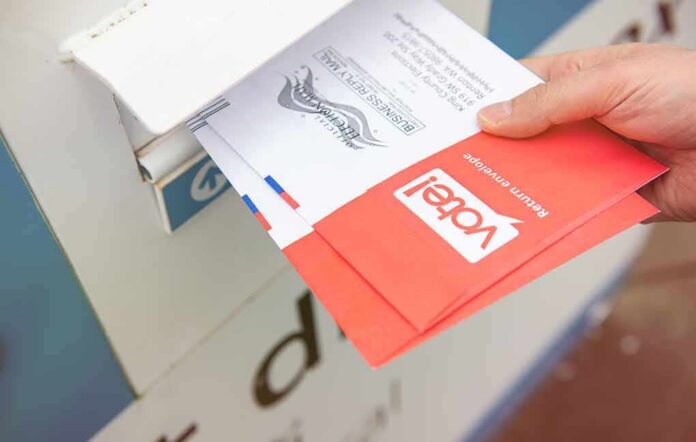
A federal judge said the Postal Service overstepped its authority and blocked key parts of its mail-ballot rule, dealing a major blow to last-minute election meddling.
Story Highlights
- A federal judge issued an injunction, saying challengers are likely to win because the Postal Service exceeded its legal authority.
- The Supreme Court kept the injunction in place for the midterms, preserving existing state mail-ballot procedures.
- States argued the rule intruded on their constitutional role to run elections and forced new barcode and list-sharing mandates.
- The fight continues on the merits, but courts are resisting late-cycle rule changes that confuse voters.
Judge Finds Postal Service Likely Exceeded Its Authority
U.S. District Judge Carl Nichols granted a preliminary injunction against core parts of the Postal Service’s mail-ballot rule. The judge concluded that the challengers were likely to show the agency went beyond powers that Congress granted. Reporting quotes his view that the rule exceeded “any conception of the outer bounds” of Postal Service authority. The order halts provisions that would have let the agency condition ballot delivery on state compliance with new design, barcode, and data-sharing demands.
The lawsuit described concrete mandates that would have reshaped mail voting mechanics weeks before ballots went out. The rule required states to transmit voter lists to the Postal Service and to place unique, voter-specific barcodes on outbound and return ballot envelopes. The Postal Service could then decline to deliver ballots tied to voters not on the agency’s “enrolled” lists or to envelopes that did not meet the new standards. Court filings also flagged that the required portal was not yet functional.
Supreme Court Leaves Injunction in Place for This Election
The Supreme Court allowed the injunction to stand, which means the new Postal Service rule will not govern the midterm election now at hand. By leaving the block in place, the Court preserved the status quo that voters and states already know. The action is procedural and does not decide the merits. But it prevents a sudden, nationwide change to mail-ballot procedures this close to Election Day.
Major outlets reported that courts often avoid last-minute upheaval in election rules. Judges warn that late changes risk confusion, delivery errors, and lost ballots. This case fits that pattern. The emergency posture and timing weighed against unleashing a brand-new federal scheme through the mail stream only weeks before voting deadlines. The Supreme Court’s move keeps states on their regular timelines and processes while the case continues.
States Assert Control Over Elections; White House Cites Integrity
A coalition of state attorneys general and election officials argued that the Postal Service cannot set national conditions for ballot delivery. They said the Constitution and federal law leave election administration to the states and Congress, not to a shipping agency. Their brief highlighted how the rule would force list uploads, barcode redesigns, and federal gatekeeping of ballot mail—functions states say they alone control. The judge agreed they are likely to prevail under the statutes at issue.
The White House and the Postal Service framed the effort as an election-integrity measure. The March directive said unique ballot envelope identifiers could help ensure that only citizens receive and cast ballots and that the right ballots reach the right people. Supporters argued barcodes create an auditable trail and reduce fraud risk. But the court’s order turns on legal authority, not policy goals. Even if some controls may be helpful, an agency still must act within the powers Congress gave it.
What Voters Should Expect and What Comes Next
Voters should expect their state’s existing mail procedures to remain in place for this election. Ballots will move under the usual state rules for envelopes, postmarks, and return timelines. The Postal Service will deliver ballots without enforcing the blocked barcode and list‑enrollment conditions. States do not need to upload voter lists to a new federal portal or redesign envelopes to meet new federal specifications for this cycle.
The Supreme Court rejected the administration's mail-voting restrictions for the midterms—rules that would have required uniform ballot envelopes and voter names submitted through an online portal before USPS delivered ballots.
Info for GA voters: https://t.co/VF0EGbSSQE
— FairCount.bsky.social (@faircount) October 7, 2026
The legal battle is not over. The Supreme Court’s action leaves room for further litigation after the election. The district court will proceed on the merits, including full briefing on statutory limits under the Postal Reorganization Act and election law. For now, the courts signaled a clear message: do not rewrite the rules of voting by mail at the last minute from Washington, and do not sideline the states that the Constitution tasks with running elections.
Sources:
redstate.com, whitehouse.gov, reuters.com, cnbc.com, oag.ca.gov, cfr.org