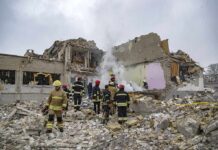


Russia’s latest overnight missile and drone barrage turned Kyiv’s neighborhoods into a war zone, killing dozens of civilians while Moscow insists it was only striking “military” and energy targets.
Story Snapshot
- Russian forces launched one of the deadliest mass missile and drone strikes on Kyiv this year, killing and injuring scores of civilians.
- Moscow claims it hit only military, energy, and drone-production sites, but reporting shows apartment blocks, schools, and offices smashed.
- The attack used advanced weapons, including hypersonic missiles and hundreds of drones, raising questions about Ukraine’s air defenses.
- The strikes highlight how fast modern war can turn big cities into rubble, and why Americans must stay alert to global threats and defense gaps.
Deadly Overnight Barrage Hits Kyiv Neighborhoods
Ukrainian officials report that Russia launched one of the deadliest overnight strikes on Kyiv of the entire war, sending waves of missiles and drones into the capital and surrounding areas. The attack lasted for hours and was described as a “massive” assault that shook the city through the night. Residential buildings, offices, and other civilian sites were hit, leaving streets covered with debris, shattered glass, and burned-out cars. Local emergency crews worked through the dark to pull survivors from damaged apartment blocks and fight fires in several districts across Kyiv.
Authorities say the strikes killed at least 27 to 30 people and wounded many more, with some reports citing over 90 injuries in Kyiv alone. Casualty numbers vary among outlets, but all agree the human cost was high and that families were caught in their homes when the missiles came in. Photos and video from the scene show collapsed facades and blown-out interiors, proof that ordinary residents, not just soldiers, bore the brunt of the assault. The city’s mayor has repeatedly called these attacks some of the largest and most destructive since Russia’s full-scale invasion began.
Russia’s Claim: “Precision” Strikes on Military and Energy Sites
The Russian Defense Ministry publicly framed the operation as a long-range “precision” strike on legitimate targets, saying its weapons hit military command centers, energy facilities, airports, and drone-production sites in Kyiv and other regions. Moscow also claimed the barrage was retaliation for Ukrainian drone attacks on civilian sites inside Russia, a line it has used often to justify escalation. Russian statements stressed that the focus was on Ukraine’s defense industry and infrastructure, including locations used by ground forces and military intelligence. In Russian media and aligned outlets, the strike was described as part of a broader effort to shut down Ukraine’s ability to build and launch drones.
However, independent reporting from Western outlets and Ukrainian authorities does not match that narrow military picture. Journalists on the ground describe extensive damage to homes, schools, offices, and even what appears to be an ambulance station, all far from any obvious front-line battlefield. Emergency services listed fires and destruction across multiple civilian districts, showing that whatever Russia claims it aimed at, the impact landed squarely inside normal city life. This gap between stated “precision” targeting and clear civilian harm has become a repeated pattern in the Russia-Ukraine war.
Scale of the Attack and Strain on Air Defenses
Ukraine’s air force says Russia has increasingly used large mixed salvos to overwhelm defenses, combining ballistic missiles, cruise missiles, kamikaze drones, and newer hypersonic weapons in single overnight waves. In one major strike, Russian forces launched around 90 missiles and 600 drones nationwide, with many aimed at Kyiv; even with heavy interception rates, several got through and hit civilian areas. In another reported assault, Ukraine’s air force counted 74 missiles and nearly 500 drones in one night, calling it among the deadliest attacks on the capital this year. These numbers show how sheer volume can punch through even modern air defenses and leave cities exposed when interceptor missiles run short.
Ukrainian officials have warned about a serious shortage of interceptor missiles, noting that in at least one “massive” attack, none of the 23 incoming ballistic missiles over Kyiv were shot down. When dozens of ballistic missiles and hundreds of drones come in at once, radar systems, launchers, and crews all face a crushing load, making it easier for some weapons to slip past. Fires broke out in at least five districts of Kyiv after one such strike, according to state emergency services, demonstrating how even partial failure of defense can translate into major civilian damage. From a security standpoint, these attacks are a live test of how well layered defenses can protect big cities under sustained pressure.
Human Toll and What It Means for American Readers
Behind every casualty number is a family whose home turned into a battlefield overnight. Reports from Kyiv speak of residents trapped in collapsed buildings, children pulled from rubble, and people killed while simply sleeping in their beds. Office workers, students, and shop owners woke up to broken windows, scorched walls, and streets lined with emergency vehicles. For many Ukrainians, these repeated strikes erode the basic sense of safety that should be normal in any capital city, replacing it with constant fear of the next siren.
Nine killed, 22 injured in Russian missile and drone attack on Kyiv
At least nine people were killed and 22 injured after Russia launched a massive overnight missile and drone attack on Kyiv. The strikes damaged residential buildings and sparked fires.#Russia #Ukraine #War pic.twitter.com/1PiWJkKjoi
— Ritam English (@english_ritam) August 1, 2026
For Americans, especially readers who value strong national defense and limits on foreign entanglements, this attack is a sobering reminder of how quickly advanced weapons can shatter an urban center. It raises tough questions about how the United States and allies handle missile threats, stock interceptor missiles, and balance aid abroad with readiness at home. It also shows the brutal reality of wars fought with drones and hypersonic missiles, where civilians often pay the highest price even when militaries claim “precision” and “strategic” targeting. Watching Kyiv endure these barrages, many will rightly ask how to protect our own cities, our Constitution, and our families from similar chaos in a more dangerous world.
Sources:
bbc.com, abcnews.com, reuters.com, cbsnews.com, theguardian.com, kyivindependent.com, youtube.com