
Russia’s latest five‑hour missile and drone barrage over Kyiv exposed just how thin Ukraine’s air defenses have been stretched by years of war and Western delays.
Story Snapshot
- Russia launched one of its biggest ballistic missile attacks of the war on Kyiv, using dozens of missiles and more than a hundred drones.
- At least one person was killed and more than a dozen injured, as fires and damage hit residential and non‑residential buildings across the capital.
- Ukrainian officials say they lack enough interceptor missiles, leaving many ballistic missiles to strike targets unchecked.
- The attack fits Russia’s broader “coercion by salvo” strategy, using mass strikes to terror civilians and pressure Ukraine and its Western backers.
Russia’s Overnight Barrage on Kyiv
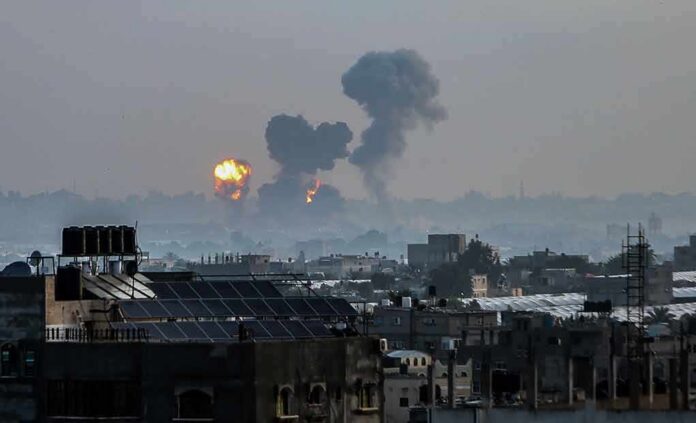
Ukraine’s Air Force reported that Russia launched 41 missiles and 125 attack drones overnight into July 19, with Kyiv as the main target. The strike package included 10 Zircon hypersonic missiles, 25 Iskander-M ballistic missiles, and several other types of rockets, making it one of the largest ballistic salvos against the capital since the war began. Local monitoring channels estimated roughly 40 missiles fired at Kyiv in only 53 minutes, underscoring the intensity of the assault. Explosions and air raid sirens sounded across the city for hours as residents sheltered underground.
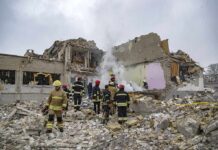
Kyiv’s military administration and city officials said at least one person was killed and around 15 to 16 people were injured in the early morning attack. Fires broke out in multiple districts, hitting residential buildings and a non‑residential site, where a blaze was later contained. Emergency crews worked through the night to put out fires, rescue trapped residents, and clear debris from streets and courtyards. Videos from the city showed shattered windows, burned‑out cars, and apartment blocks scarred by shrapnel and falling wreckage.
Strain on Ukraine’s Air Defenses
Ukraine’s Air Force and Kyiv officials highlighted a serious shortage of interceptor missiles, especially against ballistic and hypersonic threats. In earlier July attacks, Ukraine reported that all 29 ballistic missiles in one salvo hit their targets because interceptors had run low, leaving defensive batteries unable to engage every incoming rocket. Ballistic missiles travel at high speed along steep trajectories, which makes them difficult to shoot down even with modern systems. When stockpiles of missiles for those systems run short, more rockets get through and hit homes, hospitals, and power stations.
Officials in Kyiv have warned that Russia is exploiting these gaps by firing “everything at once” — drones, cruise missiles, and ballistic missiles — to overwhelm air defenses and force Ukrainian crews to make painful choices about which threats to engage. In the July 19 strike, Ukrainian air defenders still downed most of the drones, but they could not intercept every ballistic missile aimed at the city. President Volodymyr Zelenskyy used the attack to renew public appeals to Western partners for more air defense interceptors, arguing that each delay increases the human cost on the ground. For Americans who value strong national defense, this pattern is a warning of what happens when promises are not backed up with real supplies.
Russia’s “Coercion by Salvo” Strategy
Security analysts describe Russia’s approach as “coercion by salvo,” a strategy that uses massed strikes to punish civilians and signal that Moscow can escalate at will. Throughout 2026, Russia has launched large combined attacks on Kyiv and other cities, often firing hundreds of drones and dozens of missiles in a single night. One early July strike on Kyiv killed at least 27 people and injured 91, making it the most deadly attack on the capital that year. Another barrage days later killed 22, with most casualties in Kyiv and nearby towns. The July 19 strike fits the same pattern: heavy use of ballistic missiles and hypersonic weapons, timed to cause fear and chaos.
🇷🇺 Drone crews of the 20th Motor Rifle Regiment of Russia’s Southern Group of Forces intercepted and destroyed a Ukrainian fixed-wing "Blyskavka" UAV.
The enemy drone was detected in flight, tracked from the air and engaged before it could reach its assigned target.
The… pic.twitter.com/0xpfMBhbTF
— Super Poutine (@SPoutineFR) July 19, 2026
Ukraine responds by stressing the civilian impact, pointing to burned apartment blocks, damaged hospitals, and destroyed aid warehouses to push Western governments for faster deliveries of missiles and guns. Russia, in turn, often claims it is hitting fuel depots, logistics hubs, or military sites, and uses Ukrainian strikes on Russian oil facilities as justification for new salvos. For American readers, the lesson is clear. When an aggressive power sees weakness or delay from the West, it doubles down. Ballistic missiles raining down on Kyiv’s neighborhoods are a sobering example of what unchecked escalation looks like — and a reminder that defending innocent lives abroad is tied to defending stability and U.S. interests at home.
Sources:
youtube.com, reuters.com, internazionale.it, anews.com.tr, kyivindependent.com, newindianexpress.com, instagram.com, understandingwar.org