
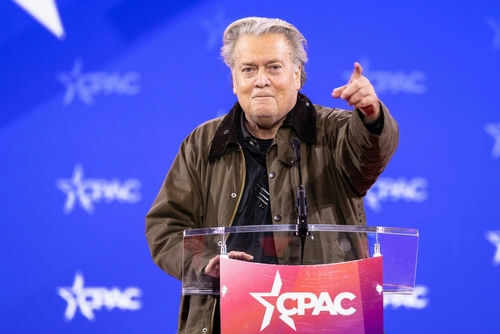
A Trump ally’s call to put ICE and even Army troops around polling sites is reigniting a hard constitutional question: who controls U.S. elections—states, or Washington?
Quick Take
- Steve Bannon urged President Trump to deploy ICE around polling places during the November 2026 midterms, arguing it would stop alleged illegal voting.
- Bannon escalated the idea by calling for U.S. Army units to enforce voter ID and citizenship checks under the Insurrection Act.
- The White House publicly denied hearing of any formal plan to station ICE at polling locations.
- Legal and constitutional constraints—including the Posse Comitatus Act and state-run election rules—make troop or federal-agent deployments at polls a high-risk legal fight.
Bannon’s “ICE at the polls” push collides with constitutional lines
Steve Bannon used his “War Room” platform in early February 2026 to argue that Immigration and Customs Enforcement should “surround the polls” in November. He tied the idea to claims that Democrats depend on illegal immigrants voting—a serious allegation that, in the research provided, is presented as an asserted rationale rather than demonstrated evidence. The proposal instantly raised alarms because it shifts election security from local election officials to federal enforcement muscle.
Bannon’s follow-up went further than a generic voter-integrity argument. He reportedly invoked the Insurrection Act and specifically named major Army units, including the 82nd and 101st Airborne Divisions, as a way to “nationalize” election enforcement and compel voter ID and citizenship verification at voting sites. That matters because it is not just about tightening registration rules; it is about federalizing physical presence and enforcement at polling locations—an idea that cuts across normal state election administration.
What the White House said—and what’s actually confirmed
PBS NewsHour coverage highlighted a clear limitation in what’s confirmed: the White House said it had not heard President Trump discuss “any formal plans” to put ICE outside polling locations and dismissed the premise as “a disingenuous question.” In other words, Bannon’s comments are real and widely reported, but they do not automatically equal policy. As of the latest reporting referenced in the research, there is no confirmed operational plan for ICE deployments at polls.
The broader political environment, however, is already heated. The research notes an administration push for greater federal involvement in election administration, ongoing legal fights involving voter rolls, and an active dispute over the SAVE Act’s requirement for documentary proof of citizenship for voter registration. Those debates are not just partisan theater; they shape what states will accept, what courts will block, and how far federal agencies can go before lawsuits land and injunctions follow.
The legal tripwires: Posse Comitatus, state authority, and intimidation claims
Federal law sharply constrains using the military in domestic law enforcement, and the research points to the Posse Comitatus Act and related rules as major barriers to troops at polls. The Brennan Center for Justice is cited arguing that federal law enforcement at polling places is generally unlawful except in narrow circumstances, such as repelling armed enemies. States also set their own election procedures, and some states restrict firearms near polling places—an added complication when rhetoric starts sounding like “force protection.”
This is where many conservative voters—especially those exhausted by post-9/11 mission creep and now watching a new war with Iran unfold—are likely to feel whiplash. A constitutional conservative case for election integrity is strongest when it relies on clean voter rolls, transparent chain-of-custody, and state-level reforms passed through legislatures. A case for federal agents and troops physically hovering around polling sites is far easier for opponents to frame as intimidation, and it risks handing federal power a new domestic precedent that could be used later against conservatives.
GOP tension is real: election integrity vs. federalization
The research highlights a split that matters for 2026: some Republicans back tougher citizen-only voting rules while still opposing “federalizing” elections as a constitutional problem. Senate Majority Leader John Thune is cited warning of a “constitutional issue,” signaling that even within the pro-Trump coalition there are red lines. Democrats, meanwhile, are already positioning the SAVE Act and related enforcement talk as discriminatory and as a modern version of voter suppression, further guaranteeing courtroom battles.
The unresolved question is not whether election security matters—it does—but whether Washington can, or should, override the states with law-enforcement presence at voting sites. The research also notes former Attorney General Bill Barr previously said there was no evidence to support broad 2020 fraud claims, which continues to undercut arguments built on sweeping allegations rather than provable, case-by-case violations. With midterms ahead, the most durable reforms are likely the ones that survive judicial review and don’t invite a constitutional crisis.
Sources:
Steve Bannon calls for Trump to deploy ICE and military troops to polling sites
Bannon urges ICE to surround polls in November as election federalization debate grows
Steve Bannon urges ICE to surround polls in November