

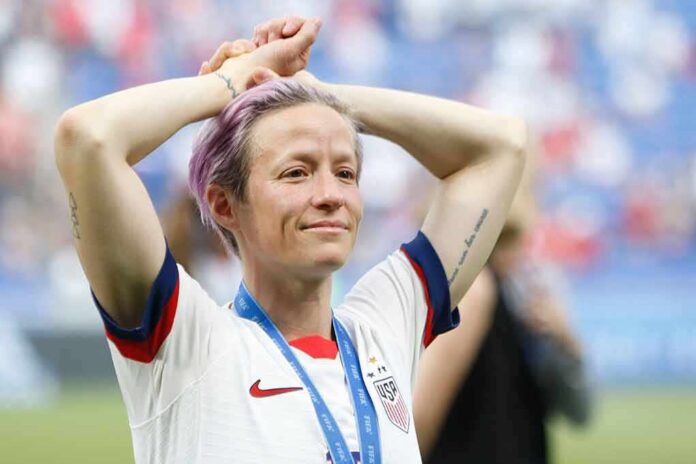
Megan Rapinoe called Enes Kanter Freedom a “bad-faith actor” for defending women’s sports, and Freedom fired back by doubling down on biology-based fairness.
Story Highlights
- Rapinoe backs transgender inclusion in women’s sports and dismisses critics as acting in bad faith.
- Freedom says his stance protects women and Title IX, not attacks transgender people.
- Freedom’s WNBA “declaration” aims to test league eligibility rules and spotlight fairness concerns.
- Federal policy under President Trump reinforces sex-based sports categories in schools.
Rapinoe’s Position: Trans Inclusion Over Sex-Based Categories
Megan Rapinoe has long argued that transgender women should compete in women’s sports. In past interviews, she said she is “100 per cent” for inclusion and would “absolutely” support a transgender player on the United States women’s team, even if it replaced a non-transgender player. Rapinoe now says people who push to keep women’s categories based on biological sex are acting in bad faith. She mocked Enes Kanter Freedom’s “protect women” message and tied it to exclusion, not fairness.
Rapinoe often frames the debate as a civil rights issue. She argues that bills or rules that limit transgender athletes solve no real problem and instead target a small minority. She has criticized bans from major sports bodies and claimed they are not rooted in science but in fear and politics. Her comments draw support from activists but also spark pushback from women who want sex-based categories to remain the standard at every level of play.
Freedom’s Response: Pro-Woman, Not Anti-Trans
Enes Kanter Freedom rejects Rapinoe’s charge. He says he is not against transgender people and is only standing up for women’s sports and privacy. He argues that men do not belong in women’s spaces, locker rooms, or leagues and that saying so should not be punished or smeared. He frames the issue as common sense: protect fair play and safety for girls and women, and keep sex-based divisions that let female athletes compete on a level field.
Freedom has tried to expose what he calls a double standard by declaring for the 2027 Women’s National Basketball Association draft. Reports note the Women’s National Basketball Association agreement says only women can play, and league sources say he is not eligible. His move is a protest to press the policy question and draw clear lines around eligibility in women’s sports. He says the point is to force clarity, not to join the league, and to show why rules based on gender identity alone break fairness for women.
Policy Backdrop: Title IX, Schools, and Federal Direction
The legal fight sits on top of school sports rules and federal policy. Title IX has long allowed sex-separated teams while requiring equal chances for girls and boys. In 2025, President Trump signed an executive order that directs the Education Department to keep men out of women’s sports in federally funded schools. That sets a clear federal stance for K-12 and college programs that take public money, though courts may still hear specific disputes.
Enes Kanter Freedom is firing back at Megan Rapinoe after she criticized his stance on transgender participation in women’s sports. Freedom challenged the former soccer star to a one on one match, promising to donate $5 million to a charity of her choice if she beats him.
Photo… pic.twitter.com/GNyob37gLp
— TalkRadio 77 WABC (@77WABCradio) August 28, 2026
Research and commentary across sports show deep splits on how to handle transgender participation. Some papers and surveys back sex-based categories to protect fairness, while others argue inclusion can fit in some sports with smart rules. That mix explains why leagues, schools, and states keep landing in conflict. The Women’s National Basketball Association case highlights that without bright lines, public trust erodes and athletes, parents, and coaches get dragged into constant fights.
Why It Matters to Readers
Parents, coaches, and young athletes need clear, stable rules. Women deserve fair races, safe courts, and scholarships earned on merit. When public voices brand basic concerns as “bad faith,” civil debate shuts down. Freedom’s push, even if noisy, is forcing institutions to state their standards in plain language. With the White House policy set toward sex-based fairness in schools, expect more leagues to align their rulebooks or face rising backlash from players and fans who want women’s sports protected.
What Comes Next
Leagues will likely clarify eligibility terms and enforcement. The Women’s National Basketball Association faces pressure to define who qualifies as a woman under its agreement and how it will handle protests and arena incidents. Women’s sports advocates will keep pressing for biology-based categories, while activists for transgender inclusion will push for case-by-case measures. Courts may set guardrails, but fast, transparent rules from leagues and schools can lower tensions and protect competition now.
Sources:
facebook.com, sports.yahoo.com, gbnews.com, abc.net.au, cnn.com, foxnews.com, cbsnews.com, them.us