
When presidents start governing by executive order while Congress gets boxed out, the Constitution stops being a guardrail and starts looking like a suggestion.
Quick Take
- President Trump’s second term has leaned heavily on executive actions that test how much power the White House can exert without Congress.
- A 2025 order directing independent regulatory agencies to route major rules through OMB review raises fresh questions about agency independence.
- Courts have blocked at least one major executive action on election rules, showing legal limits still exist—but enforcement is uneven.
- Reports of lawmakers being denied access to agencies for oversight add pressure to a system that relies on checks and balances, not loyalty.
Executive Power Is Expanding, and the Guardrails Are Getting Thinner
President Trump’s second term, which began in January 2025, has featured a rapid pace of executive orders and administrative directives that critics say push constitutional boundaries. The central issue is not whether presidents can use executive authority—every modern president has—but whether the current White House is narrowing practical oversight by reshaping the agencies meant to operate with statutory independence. The result is a fight over who governs: elected lawmakers through legislation, or the executive branch through command.
Polling and institutional analysis cited in the research suggest many Americans believe Trump is operating beyond traditional limits, with majorities saying he is exceeding or stretching presidential authority. That public skepticism matters because it signals a broader legitimacy problem: when large parts of the country believe government is running around the law, trust collapses. Conservatives who spent years warning about bureaucrats and unelected power should be especially attentive when any administration concentrates authority inside the White House.
Independent Agencies Pulled Closer to the White House
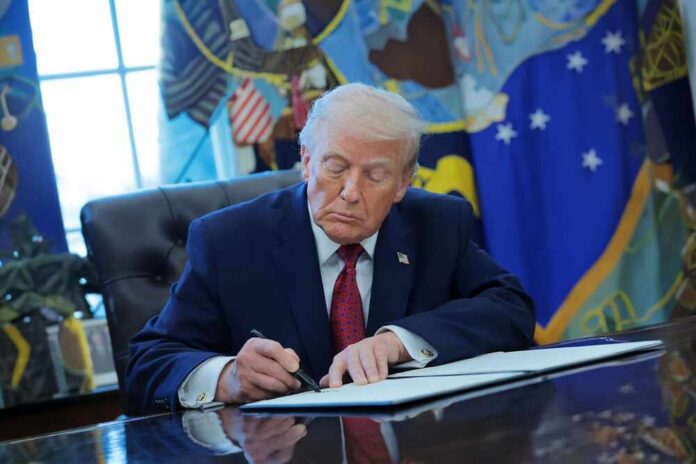
A major flashpoint came on February 18, 2025, when Trump signed an order titled “Ensuring Accountability for All Agencies.” The directive requires independent regulatory agencies to submit major regulations for Office of Management and Budget review and to establish White House liaison offices. Supporters can argue this creates accountability; the counterargument is that it effectively subordinates bodies designed by Congress to be insulated from day-to-day political control, changing how the administrative state functions without new legislation.
The practical impact is easy to grasp: if the White House can shape what independent agencies can propose, delay, or enforce, then policy moves faster—but checks become more internal and less transparent. That approach may appeal to voters tired of slow government, but it also risks setting a precedent that a future left-wing administration could use to push sweeping cultural or economic mandates through the same centralized machinery. The tool matters as much as the user.
Purges, Program Cuts, and the Oversight Question
Another major development in the research is the reported “six-week USAID purge,” announced as completed on March 10, 2025, which eliminated 83% of USAID programs. Beyond the policy debate over foreign aid, the governance issue is process: when large portions of an agency’s work vanish quickly through executive direction, Congress’s role in authorizing, funding, and overseeing federal functions becomes harder to enforce. That weakens the separation of powers conservatives routinely defend.
The research also reports lawmakers being locked out of agencies and blocked from conducting oversight, including references to access disputes involving the Department of Education. If accurate, that is not a partisan talking point—it is a structural problem. Congressional oversight is not optional; it is part of how Americans keep the executive branch from acting like a self-contained authority. When oversight depends on whether the White House feels cooperative, constitutional checks become political favors.
Courts Can Stop Some Actions, but Not All
The federal courts remain one of the clearest remaining constraints, and the research highlights a notable example: Trump’s March 25, 2025 executive order on federal election rules was challenged and later struck down in court, with the Campaign Legal Center citing that win. That outcome reinforces a basic reality—executive actions can be reversed when they exceed legal authority. However, lawsuits take time, and courts typically address specific actions rather than the broader pattern of consolidation.
Constitutional scholars cited in the research also emphasize a bright-line limit: abolishing federal agencies requires Congress, not unilateral presidential action. That distinction matters for conservatives who want smaller government but also want lawful government. If the executive branch can effectively dismantle agencies without Congress, then a future administration could just as easily dismantle border enforcement priorities, reshape gun policy enforcement, or pressure regulators in ways that bypass voters’ representatives.
What This Means for Conservatives Who Wanted “No More Endless Wars”
The research centers on executive power at home, but it intersects with a larger frustration inside the MAGA coalition: many supporters backed Trump expecting fewer foreign entanglements and less permanent-crisis governance. When any presidency normalizes governing by decree—especially while oversight is contested—it becomes easier to slide into major commitments abroad without the country getting a full, transparent debate. A government built for limited power cannot stay limited if Congress is sidelined.
The bottom line from the available reporting is mixed: institutional checks still function in places, especially in court, but several internal and congressional constraints appear weaker than they were in prior eras. Conservatives should not have to choose between supporting Trump’s agenda and supporting constitutional structure. The American system works best when it restrains everyone—friends and foes—because the restraint is what prevents the next administration from using the same playbook against your rights, your state, and your family.
Sources:
https://trumpwhitehouse.archives.gov/trump-administration-accomplishments/
http://cohen.house.gov/TrumpAdminTracker
https://www.whitehouse.gov/achievements/
https://www.politico.com/news/magazine/2026/01/19/25-things-trump-first-year-00727584
https://campaignlegal.org/CanTrumpDoThat
https://www.whitehouse.gov/priorities/