
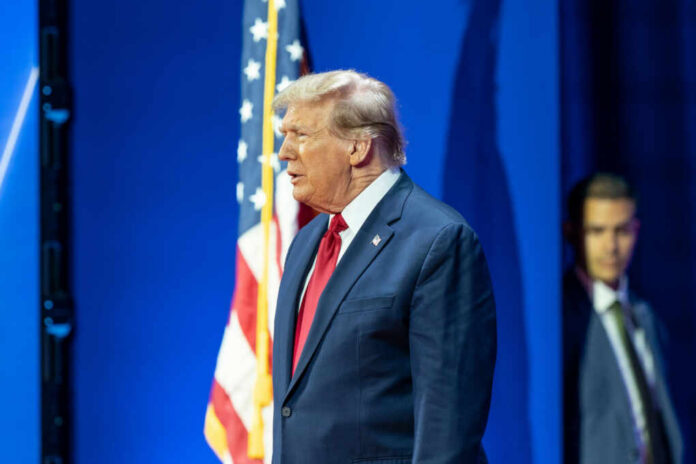
President Trump has formally launched a military coalition with 12 Latin American nations to wage war against drug cartels, marking the most aggressive hemispheric security operation since the Cold War.
Story Snapshot
- Trump signed a proclamation establishing the “America’s Counter Cartel Coalition” at his Doral, Florida property on March 7, 2026
- The initiative authorizes expanded U.S. military operations across Latin America, including precision missile strikes against cartel targets
- Former DHS Secretary Kristi Noem was reassigned as Special Envoy while Senator Markwayne Mullin takes over Homeland Security
- Twelve allied Latin American leaders pledged cooperation in the coordinated military effort to dismantle cartel networks
Trump Declares War on Cartels with Military Force
President Trump hosted the Shield of the Americas Summit at his Doral property, where he signed a formal proclamation launching a hemispheric military coalition against drug cartels. Joined by Secretary of State Marco Rubio and 12 Latin American leaders, Trump emphasized the necessity of military solutions, stating: “The only way to defeat these enemies is by unleashing the power of our militaries. We have to use our military. You have to use your military.” The coalition represents a dramatic escalation in counter-narcotics operations, moving beyond law enforcement approaches to full military engagement against criminal organizations that have terrorized communities across the hemisphere.
Trump committed to deploying advanced military capabilities, including precision missile strikes, against cartel infrastructure and leadership. This approach marks a fundamental shift from previous administrations that treated cartel violence as primarily a law enforcement issue. The President positioned the initiative as essential to protecting American sovereignty and border security, claiming his administration has achieved “the best strongest border that we’ve ever had” through decisive action. The coalition aims to coordinate intelligence sharing and joint military operations across member nations under U.S. leadership.
Strategic Restructuring and Leadership Changes
Concurrent with the coalition announcement, Trump restructured his national security team by creating the position of Special Envoy for the Shield of the Americas and appointing former Homeland Security Secretary Kristi Noem to the role. Senator Markwayne Mullin was simultaneously announced as Noem’s replacement at DHS, ensuring continuity in border enforcement operations while expanding the administration’s counter-cartel capabilities. This personnel realignment demonstrates the administration’s commitment to prioritizing hemispheric security as a core national interest, elevating cartel interdiction to the same strategic level as traditional military threats.
The initiative addresses growing concerns about hostile foreign influence in the Western Hemisphere, with Trump specifically mentioning threats to critical infrastructure like the Panama Canal. By positioning the United States as the leadership force coordinating allied military capabilities, the coalition establishes clear American authority over regional security architecture. Trump referenced his track record of ending eight wars during his previous administration, framing the cartel coalition as consistent with his America First foreign policy that protects vital national interests without unnecessary global entanglements.
Renewed Commitment to Border Security and Sovereignty
The Shield of the Americas represents the culmination of Trump’s longstanding commitment to securing America’s borders and eliminating the cartel networks that fuel illegal immigration and drug trafficking. Trump emphasized that the coalition targets an enemy that previous administrations accepted as an inevitable reality, rejecting the defeatist notion that cartel violence constitutes a “new normal.” The military-focused approach reflects conservative principles of decisive action against clear threats to American security and sovereignty, replacing the weak enforcement policies that allowed cartels to flourish under previous leadership.
The coalition’s twelve participating nations provide geographic coverage across critical drug trafficking routes and cartel operational territories. By deepening military cooperation with allied governments, the initiative creates a unified front against criminal organizations that operate across borders with impunity. This coordinated approach addresses the fundamental problem that cartels exploit: the inability of individual nations to combat transnational criminal networks acting with military-grade weapons and organizational capabilities. The administration’s willingness to deploy American military power alongside allied forces demonstrates the seriousness with which Trump views the cartel threat to hemispheric stability and American national security.
Sources:
The United States to Host the Shield of the Americas Summit – U.S. Department of State
President Trump Delivers Remarks to the Shield of Americas Summit – The White House