
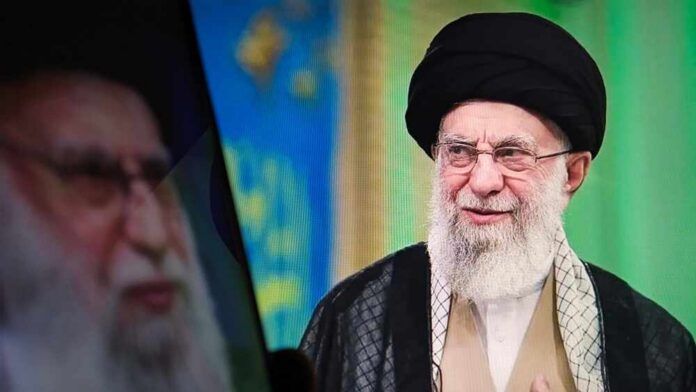
Iran’s red “flag of revenge” flying over a major holy site is a blunt warning that the Iran-Israel war could widen fast—and Americans may be pulled closer to the blast radius.
Story Snapshot
- Iranian state media confirmed Ayatollah Ali Khamenei’s death after joint U.S.-Israel airstrikes, then broadcast the raising of a red “flag of revenge” over the Jamkaran Mosque in Qom.
- The flag’s message and timing draw on Shia martyrdom symbolism tied to Imam Hussein, signaling retaliation rather than reconciliation.
- Iran announced a three-member interim Leadership Council as the Assembly of Experts begins the process of selecting a successor.
- Reports described mass mourning in Iran alongside signs of internal division, with some accounts noting cheers in parts of Tehran after the strike.
- Regional protests and unrest were reported across several countries, underscoring how quickly the conflict’s political aftershocks are spreading.
Red Flag Over Qom Sends a Clear Signal of Retaliation
Iranian state-linked outlets reported that a red “flag of revenge” was raised atop the Jamkaran Mosque in Qom on Sunday, one day after Ayatollah Ali Khamenei was killed in joint U.S.-Israel airstrikes. Footage described the ceremony as a public vow to avenge his death, with the flag carrying language tied to “Revenge for Imam Hussein.” In practical terms, the symbolism functions as a warning to adversaries that Iran’s leaders are under pressure to respond.
Jamkaran is not a random location. Qom is a central hub of Iran’s religious establishment, and Jamkaran is associated with Shia tradition and the expectation of the Mahdi. Reporting also emphasized that the same red-flag imagery appeared in 2020 after the killing of IRGC commander Qassem Soleimani, a moment that preceded Iranian missile strikes on U.S. targets in the region. The precedent does not guarantee a repeat, but it shows how Iran uses religious theater to frame state action.
What the Strike Changed: Leadership Transition Under Wartime Pressure
Iran’s immediate political response included the formation of a three-member interim Leadership Council, with names reported as Alireza Arafi, President Masoud Pezeshkian, and Chief Justice Gholamhossein Mohseni Ejei. Under Iran’s system, the Assembly of Experts is tasked with selecting a permanent Supreme Leader, but the timeline and internal consensus are unclear. Wartime conditions compress decision-making and raise the risk of miscalculation if rival power centers compete to appear toughest.
U.S. and Israeli messaging, as described in reporting, treated Khamenei’s death as a strategic opening. Statements attributed to President Donald Trump characterized Khamenei as a uniquely malignant figure and urged Iranians to rise up, while Israeli leadership argued the moment could accelerate regime change. Those political messages matter because Iran’s leadership and security apparatus often interpret outside calls for uprising as proof of foreign intent—fuel for retaliation narratives that can mobilize hardliners and street supporters.
Mourning Crowds, Protest Waves, and Signs of a Split Inside Iran
Coverage described large mourning gatherings in multiple Iranian cities and protests abroad, including demonstrations reported in Iraq, India, and Pakistan, with some incidents turning violent. At the same time, some accounts noted cheers in parts of Tehran after the strike, suggesting real internal division about the regime’s direction and the cost of confrontation. The available reporting does not quantify nationwide sentiment, but it does show a country experiencing shock, grief, anger, and political strain simultaneously.
Why This Symbolism Matters for Americans Watching From Home
For U.S. audiences, the red flag is not just a cultural detail; it is a public commitment device. When a regime wraps its next move in sacred symbolism, it narrows the space for leaders to de-escalate without looking weak. That dynamic can drag Washington into deeper involvement, whether through force protection, counterstrikes, or expanded deployments. Americans who value limited government and constitutional restraint should watch closely for clear objectives, defined authorities, and an honest accounting of risks.
Blow up the mosque.
Problem solved.
💥
**
Iran Raises the ‘Red Flag of Revenge’ Over Jamkaran Mosque After Death of Ayatollah Khamenei https://t.co/VyQIrxH5nY— Chuck Nellis The Phoenix (@ChuckThePhoenix) March 1, 2026
The reporting also leaves key gaps. Public sources cited state media, and details about operational targets, casualty figures beyond Khamenei, and Iran’s near-term retaliatory planning were limited or not independently verified in the provided material. What is clear is the direction of travel: an escalatory symbol, a rushed leadership transition, and international spillover. In a region where one strike can trigger a chain reaction, sober analysis matters more than slogans.
Sources:
US-Israel Attacks Iran LIVE Updates: Iran Hoists Red Flag
Red ‘flag of revenge’ raised in Qom: What it means for Iran and the region