

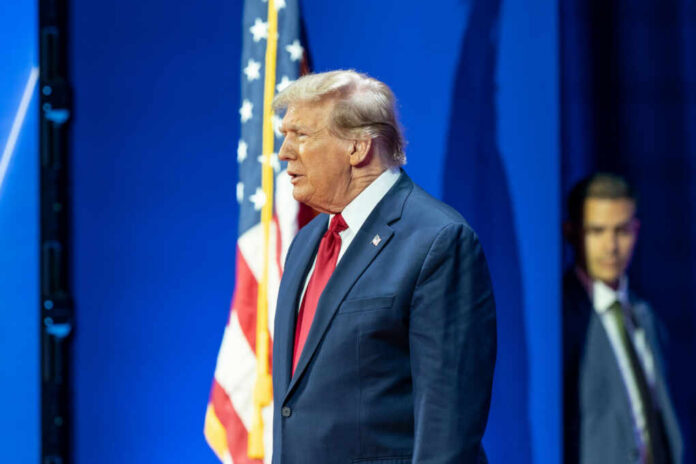
President Trump’s ultimatum tying government shutdown resolution to a controversial voter ID bill has exposed deep fractures within the Republican Party while Americans watch essential services grind to a halt over a solution to a problem that barely exists.
Story Snapshot
- Trump demands passage of SAVE America Act requiring in-person citizenship proof for voter registration before ending government shutdown
- Senate math dooms the bill with GOP rebels joining Democrats in opposition, but Trump forces floor fight anyway
- Non-citizen voting occurs at near-zero rates nationally, yet bill would disenfranchise millions lacking passports or birth certificates
- Government shutdown drags on as GOP strategy focuses on forcing Democrats into politically damaging votes ahead of 2026 midterms
Trump’s Shutdown Gambit Divides Republican Ranks
President Donald Trump issued a firm ultimatum in early March 2026, insisting Republicans reject any deal to end the partial government shutdown unless Democrats support the Safeguarding American Voter Eligibility Act. The SAVE America Act, which passed the House earlier this year, requires Americans to present in-person proof of citizenship such as passports or birth certificates to register to vote. Trump’s hardline stance has created a standoff that threatens to prolong the shutdown indefinitely, even as several GOP senators openly oppose the bill’s federal overreach into state-run election systems.
Senate Majority Leader John Thune launched floor proceedings on March 24, acknowledging the bill lacks the 60 votes needed to overcome a Democratic filibuster. Thune admitted the strategy centers on “the math,” with Republicans hoping to force vulnerable Democrats into politically costly votes against election integrity measures before November’s midterms. GOP rebels including Senators Thom Tillis and Lisa Murkowski have signaled opposition, with Tillis preferring state-level incentives over federal mandates and Murkowski warning of election administration chaos. This internal dissent underscores growing conservative frustration with Washington theatrics that prioritize political messaging over practical governance.
The Federal Power Grab Behind Election Integrity Claims
The SAVE America Act goes far beyond traditional voter ID requirements, representing a fundamental shift of power from states to the federal government. The bill prohibits online and mail-in voter registration entirely, forcing all Americans to appear in person with documentary proof of citizenship. Standard forms of identification like driver’s licenses would no longer suffice. Political scientist Constance Mixon notes the legislation would effectively purge existing voter rolls, requiring re-registration under the new federal standards. This federal takeover of traditionally state-controlled election administration raises serious constitutional questions that should concern limited-government conservatives.
Over 50 percent of Americans lack passports, with obtaining one costing approximately $160 plus the time and documentation required. Birth certificates present additional hurdles for elderly Americans born at home, married women whose names changed, and low-income citizens who cannot easily access vital records offices. The bill’s supporters frame these requirements as necessary safeguards against non-citizen voting, yet the data reveals a starkly different reality that should give pause to anyone valuing evidence-based policymaking over political posturing.
Solving a Problem That Doesn’t Exist
Research across multiple states reveals non-citizen voting occurs at statistically insignificant rates, undercutting the primary justification for the SAVE Act’s sweeping restrictions. Georgia documented a non-citizen voting rate of 0.0001 percent, while Utah recorded 0.02 percent. These microscopic numbers hardly justify federal legislation that would create massive barriers for millions of legitimate American voters. Even Senator John Fetterman, a Pennsylvania Democrat, defended mail-in voting security by pointing to its successful use in Republican-controlled states, highlighting the partisan double standards at play.
Constance Mixon characterized the bill as addressing “non-existent” problems while creating very real disenfranchisement of eligible voters. This disconnect between rhetoric and reality reflects a troubling pattern where political advantage trumps practical solutions. Conservative voters who elected Trump to drain the swamp and end government dysfunction now watch their representatives manufacture crises over statistically irrelevant issues while the government remains shuttered and real problems like energy costs and foreign entanglements persist unaddressed.
Political Theater While America Suffers
Senate Minority Leader Chuck Schumer vowed Democrats would block what he termed Trump’s attempt to “ram through” voting restrictions, promising voters would render their “verdict at elections this fall.” This sets up the exact political blame game Republicans desire, but at the cost of prolonged government dysfunction. The shutdown continues affecting federal services while both parties prioritize positioning for the 2026 midterms over actual governance. GOP House members like Representative Derrick Van Orden have threatened to block any Senate funding bills lacking the SAVE Act, creating additional pressure on Senate dealmakers.
The bill’s long-term prospects remain murky even if Republicans navigate current obstacles. Democrats could reclaim the House in November 2026, effectively killing the legislation. If the GOP maintains control, supporters predict reintroduction and renewed fights. Meanwhile, state election officials face potential chaos preparing for upcoming elections amid uncertain federal mandates. This entire spectacle exemplifies the endless political warfare that exhausts Americans who simply want competent leadership focused on substantive issues like keeping us out of wars, lowering energy costs, and respecting constitutional limits on federal power rather than federalizing state functions to score political points.
Sources:
Trump Voter ID Push Faces Senate Test as GOP Rebels Threaten to Sink Bill