

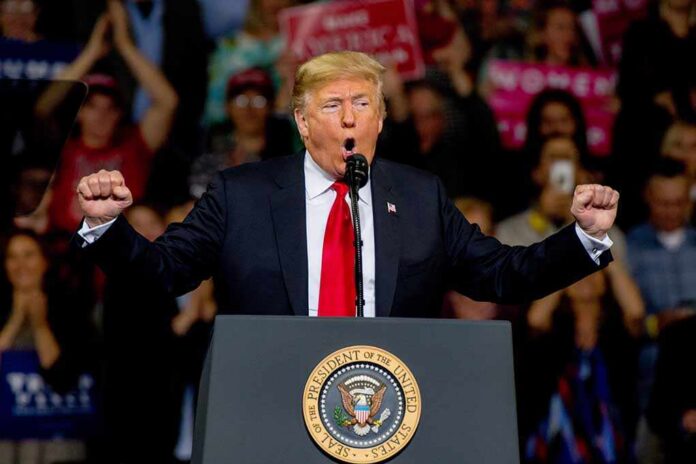
President Trump said he would consider pardoning members of his own administration before leaving office, protecting his team from what he calls future political revenge by Democrats.
Quick Take
- Trump told TIME magazine he’d be open to pardoning administration officials before his term ends.
- He pointed to Joe Biden’s blanket pardons for family and staff as his reason.
- No specific names or a finalized list of recipients has been released.
- The idea follows Trump’s earlier pardons of nearly 1,500 January 6 defendants.
- Presidential pardon power covers pre-emptive pardons and has deep historical roots.
Trump Confirms Openness to Protecting His Team
President Trump gave a direct answer when TIME magazine asked if he’d pardon members of his administration. “Yeah, sure I’d do that,” he said in an interview published Thursday. The question focused on whether he would issue pardons before leaving office, not years down the road. Multiple major outlets, including NBC News, ABC News, and the New York Post, reported the comment the same day.
Trump’s answer wasn’t a throwaway line. NBC News reported he is actively weighing a pre-emptive pardon plan for administration officials before his second term wraps up. That timing detail matters. It means Trump isn’t just answering a hypothetical question. He’s describing a real option sitting on his desk, one tied directly to how he leaves office.
Biden’s Pardons Set the Precedent, Trump Says
Trump explained his thinking by pointing straight at his predecessor. ABC News reported he cited Joe Biden’s blanket pardons for relatives and administration members, pardons Biden issued out of fear his own people would face political targeting once he left office. Trump’s logic follows the same path: if Democrats did it to shield their own, Republicans have every right to do the same for theirs.
That argument lands hard with conservatives who watched Biden hand out pardons to family members and staff without any of them facing charges first. If pre-emptive protection was fair game for Biden’s inner circle, Trump supporters see no reason the same shield should be denied to his own team now that the precedent is set.
A Pattern of Sweeping Clemency Decisions
This isn’t Trump’s first experience with large-scale pardons. NBC News and Mediaite noted he already pardoned roughly 1,500 people charged in connection with the January 6, 2021, Capitol riot, one of his first major acts back in office. PBS reported he also pardoned dozens of allies tied to challenges over his 2020 election loss. ABC News added he pardoned advisers and campaign staff during his first term as well.
Seen together, these actions show a president who treats clemency as a tool he’s willing to use broadly, not sparingly. The new TIME comment fits that same pattern rather than standing apart from it. For supporters, it signals loyalty to people who serve him. For critics, it raises questions about accountability that Trump and his team have yet to directly address in detail.
Constitutional Power, Political Debate
Legal scholars note that pre-emptive pardons, those issued before any charge or conviction, are allowed under the Constitution. The White House Historical Association points out that Abraham Lincoln issued pre-emptive pardons during the Civil War, and Jimmy Carter did the same for Vietnam draft evaders who were never even charged. Cornell Law School’s constitutional overview confirms the president’s pardon power is broad, covering offenses “either before legal proceedings are taken, or during their pendency, or after conviction”.
🇺🇸🚨 President Donald Trump says he may pardon members of his administration and other allies, pointing to the broad use of presidential pardons under Joe Biden as a precedent.
Trump argued that Biden’s use of the pardon power changed the political and legal landscape, saying:… pic.twitter.com/9BlxyTFR6Q
— Profilo politics (@profilopolitics) October 1, 2026
No pardon order has been signed, and no list of names has been made public. Trump’s comment remains a statement of willingness, not a completed action. Still, the power to issue such pardons is firmly rooted in Article II, and Trump has shown before he won’t hesitate to use the full weight of that authority when he believes his people need protecting.
Sources:
youtube.com, nbcnews.com, yahoo.com, nypost.com, news.vt.edu, motherjones.com