

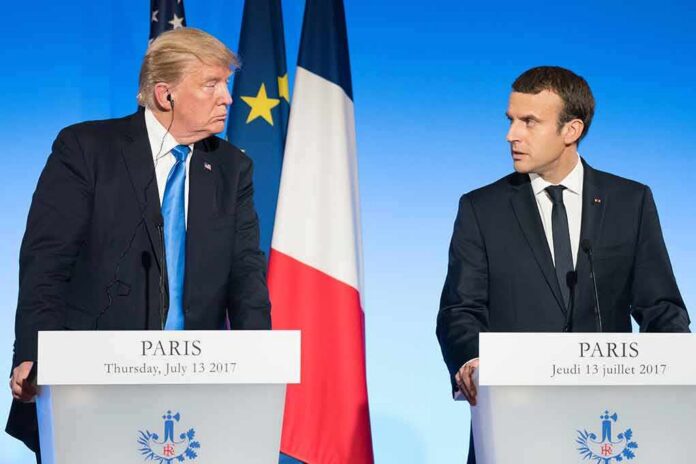
President Trump and French President Emmanuel Macron set a high-stakes meeting in New York tonight as global crises test American leadership and sovereignty.
Story Highlights
- The White House scheduled a Trump–Macron bilateral in New York at 5:35 p.m. Monday.
- Both leaders are in town for the United Nations General Assembly’s opening week.
- France signaled talks would cover Iran, Ukraine, the Middle East, and Black Sea food security.
- Reports linked the meeting to other UN sessions, including with Ukraine’s Volodymyr Zelensky.
White House Confirms Bilateral Meeting On UN Sidelines
The White House placed President Trump’s bilateral meeting with French President Emmanuel Macron on Monday at 5:35 p.m. in New York, aligning with the first day of United Nations General Assembly week. Reporting tied the meeting to Trump’s publicly listed schedule, which included the Macron session among several leader encounters planned for the high-level gathering. Coverage described the engagement as part of standard UN week diplomacy where quick, focused meetings can shape bigger moves on security and trade.
Wire services and international outlets echoed the timing and location, emphasizing that both leaders would convene in New York on the margins of the General Assembly. They noted the Monday slot reflected planning by the White House rather than rumor, reinforcing that the United States and France intended to confer early in the week. Reports also highlighted that President Trump’s calendar included other engagements tied to the same summit window, underscoring a packed agenda around core security concerns.
Macron’s Travel Track And Expected Agenda
Reporting indicated Macron would arrive in New York directly after a stop in Saint Pierre and Miquelon, where he met Canadian Prime Minister Mark Carney ahead of the United Nations events. That travel sequence set up a same-day shift from regional talks to global diplomacy with the United States. French officials previewed potential topics with Trump, including the wars involving Iran and Ukraine, tensions in the Middle East, and food security tied to Black Sea grain exports, signaling a broad and urgent docket.
France also pointed to planned activity at the United Nations Security Council during the week, particularly focused on Ukraine. That signaled Paris’s aim to leverage multiple tracks—bilateral with Washington and multilateral at the United Nations—to press priorities on war, energy, and global supply chains. The structure mirrors how leaders use the General Assembly: to stack meetings that connect military risk, sanctions, aid flows, and shipping routes that affect prices and household budgets far beyond Europe and the Middle East.
Linked Meetings And The Stakes For U.S. Policy
Contemporaneous reporting connected the Trump–Macron meeting to separate expected talks with Ukraine’s President Volodymyr Zelensky on the sidelines. That linkage places the United States at the center of wartime planning, alliance pressure, and burden sharing, which have direct effects on energy prices, defense production, and trade routes. For conservative readers, that means the White House has an opportunity to keep America’s interests first, press partners to do more, and protect domestic security and prosperity.
#UNGA81 In addition to meeting today with NYC Mayor Mamdani & French President Macron, President Trump is expected to focus in his Tuesday address on:
* Expanding the Abraham Accords & moving forward with the Board of Peace;
*U.S. leadership is necessary in setting global… https://t.co/NXeFmDwBVx pic.twitter.com/8zkuIQZHMX
— Pamela Falk Correspondent (@PamelaFalk) September 21, 2026
United Nations week typically compresses dozens of leader “pull-asides,” where the symbolism of who meets and when can shape markets and diplomacy even without long press conferences. The Trump–Macron slot fits that pattern while standing out for its scope—from Iran’s aggression to grain flows in the Black Sea. While reports center on the schedule and expected topics, the focus on Iran, Ukraine, and Middle East friction makes this meeting relevant to American energy costs, border stability, and the strength of Western alliances.
Why This Meeting Matters To American Families
Talks that push Europe to carry more of the load on Ukraine can reduce pressure on United States taxpayers and industry. A frank exchange on Iran and Middle East conflict can support policies that deter terror proxies and safeguard shipping lanes that influence fuel and grocery prices. Discussion of Black Sea grain exports can ease food inflation. When America insists on fair burden sharing and clear outcomes, families feel it in lower costs, stronger borders, and a safer world for our troops and communities.
What Is Confirmed And What Comes Next
Based on official scheduling and multiple outlets, the Monday Trump–Macron meeting in New York is set and tied to the United Nations General Assembly calendar. French statements outlined likely focus areas, and reporting linked both leaders to separate sessions with Ukraine’s president as the week unfolds. A formal readout, if released, would detail results and any concrete steps. Until then, the confirmed facts center on the timing, venue, and the main issues likely on the table.
Sources:
lepetitjournal.com, ewn.co.za, rfi.fr, sudradio.fr, freemalaysiatoday.com