

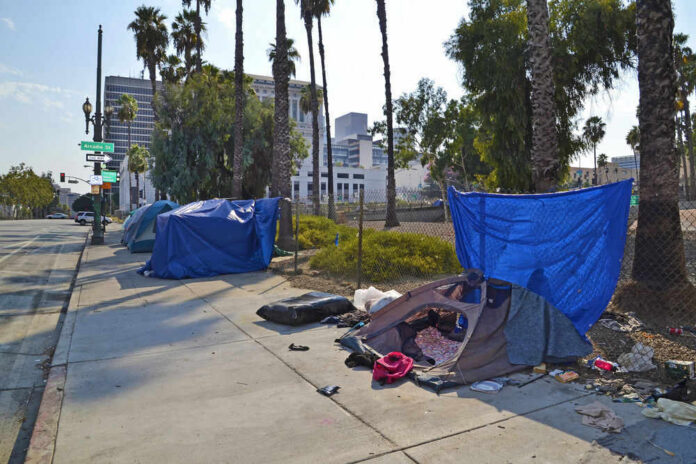
Los Angeles taxpayers have flushed $300 million down the drain on Mayor Karen Bass’ homeless program, with 40% of participants back on the streets—proof that liberal big-government schemes fail hardworking Americans yet again.
Story Snapshot
- $300 million spent by LA’s Inside Safe program since 2022, housing 5,800 people temporarily.
- 40% (2,300 individuals) returned to unsheltered homelessness by December 2025, up from 20% in 2023.
- Only 25% achieved permanent housing; 55% in some form of housing including temporary stays.
- Venice Beach encampments reemerged in 2026 despite initial clearances, frustrating residents.
Program Launch and Rising Failures
Mayor Karen Bass launched Inside Safe in December 2022 via executive order, targeting high-visibility encampments for interim hotel and motel housing. The plan aimed for permanent placement within 90 days, with a maximum six-month stay. Los Angeles Homeless Services Authority (LAHSA) dashboards tracked outcomes. By end of 2023, 20% had returned to streets. Mid-2025 saw over 30% recidivism. December 2025 data showed 40%—roughly 2,300 of 5,800—back unsheltered, including evictions, voluntary exits, or those who disappeared from the system. This trend undermines claims of progress, wasting taxpayer dollars on temporary fixes that ignore root causes like mental health and substance abuse.
Stakeholders and Defenses
Bass defends the program as an urgent response to LA’s crisis, stating to the LA Times it’s vital to learn why people leave. LAHSA provides monthly dashboards revealing the data. City of Los Angeles funds operations through Bass’ authority. Venice residents and businesses, initially hopeful after 2022-2023 clearances housing over 100, now face re-encampments in 2026. These communities demand lasting solutions, not revolving-door policies. Bass prioritizes visible reductions, but metrics favoring temporary housing over permanence erode trust among overburdened taxpayers footing repeated bills.
Impacts on Taxpayers and Communities
The $300 million expenditure yields low permanence, with permanent housing rising modestly from 15% in 2023 to 25% by late 2025. Short-term encampment clearances provide fleeting relief, but high turnover strains resources and perpetuates cycles. Venice’s notorious encampment returned three years post-clearance, angering locals. Taxpayers bear the cost of inefficiency amid California’s homelessness surge—69,144 countywide in 2022, though LA unsheltered dipped 17.5% year-over-year to about 45,000 in 2025. This highlights government overreach favoring feel-good spending over effective strategies like prevention, which show promise statewide.
Expert Views and Broader Lessons
LA Times analysis questions the 90-day permanent housing goal’s feasibility as recidivism worsens with program age. Bass views data as a learning tool, yet pessimistic takes label 40% returns a stability failure. Optimists cite 55% in some housing and citywide declines. LAHSA data remains most rigorous, corroborated across sources. Long-term, Inside Safe’s limits contrast with prevention models avoiding new homelessness. This fiasco exemplifies liberal fiscal mismanagement—inflationary overspending without results—echoing frustrations with policies burdening families while failing core duties. National debates on funding efficacy intensify as common-sense conservatives demand accountability.
Sources:
Under L.A. mayor’s $300-million homeless program, 40% have returned to street (The Independent)
Under L.A. mayor’s $300-million homeless program, 40% have returned to street (Los Angeles Times)
Inside Safe (City of Los Angeles)
A new homelessness strategy is sweeping California (LAist)
Our Challenge (LA County Homeless Initiative)