

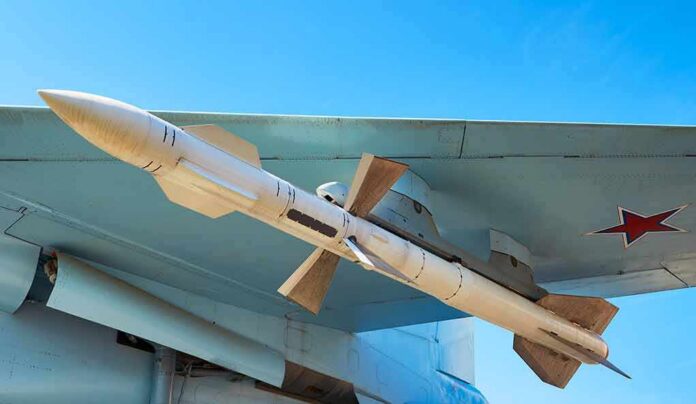
America’s next air-dominance missile just showed up in flight testing, signaling a direct answer to China’s long-range threat.
Story Highlights
- Photos show the new AIM-260 missile carried by a U.S. Navy F/A-18F during testing in Florida.
- A senior Air Force official tied the missile’s design to countering China’s PL-15 and surpassing AMRAAM’s range.
- Budget plans fund development and large-scale buys through the next decade.
- The program aims to arm front-line fighters while keeping weapons inside stealth bays.
Test Sightings Mark a Visible Step Forward
Photographs taken May 13, 2026 at Eglin Air Force Base showed a U.S. Navy F/A-18F carrying a missile identified as the AIM-260 during a test flight. The missile displayed red and yellow bands seen on test articles, signaling an active evaluation event. Multiple defense outlets published the images and tied the activity to ongoing government testing. The public sighting matters. It confirms real hardware on a front-line jet, not just briefing slides or artist images.
Additional reports described the Eglin run as part of a broader test program. The event fits with a ramp toward production and fielding. While official performance data remains classified, the visible test article and carrier aircraft show practical progress. The Navy and Air Force have moved the design from labs to air. That step is essential before any service clears a new air-to-air weapon for real operations over contested skies.
Why the Missile Exists: Countering the PL-15
Air Force weapons leadership linked the program to China’s PL-15 in 2019. Brigadier General Anthony Genatempo said the service started the Joint Advanced Tactical Missile to answer that threat and to outrange the Advanced Medium-Range Air-to-Air Missile. He called for “longer legs,” pointing to a need to strike first and stay safe. That clear statement by a program executive set the aim: restore reach and control the merge before an enemy can fire back.
The missile’s role is not theory. Reports identified Lockheed Martin as developing the weapon for both the Air Force and the Navy to replace or succeed AMRAAM. The design goal centers on more reach while fitting within internal bays on stealth fighters. That fit keeps jets like the F-35 hidden, armed, and fast. The recent test article on a Super Hornet shows cross-fleet plans. The services need a common round to simplify logistics, training, and war reserve stocks.
Money, Schedule, and What Is Still Classified
Budget documents reported by defense media show a major push. Plans include about $1.47 billion for research and development over five years, about $369 million for fiscal year 2026 procurement, and about $8.8 billion for buys from fiscal years 2027 to 2031. Those figures match a priority program meant to arm many squadrons. Funding at that scale supports test ranges, production lines, and the spares needed to sustain combat-ready units.
The program’s early target for initial capability in 2022 did not appear in public on that timeline. The first widely shared images arrived in May 2026, during testing. That does not change the mission need. It does remind us that high-end weapons face complex engineering and security rules. Performance numbers remain classified. Officials have said only that AIM-260 is built to outrange AMRAAM. Exact range and speed claims in open sources have not been confirmed by public test reports.
What It Means for U.S. Air Superiority
U.S. strategy depends on striking first and surviving. A longer-range, bay-compatible missile helps pilots control the fight. The AIM-260 is designed to give that edge to the F-22, F-35, and carrier air wings. The May 2026 flight shows the program moving from concept to combat readiness. That matters in the Pacific, where distance, sensors, and jamming define every choice. A stronger beyond-visual-range punch keeps American and allied aircrews safer at the opening shot.
China’s military has pushed range and sensors to hold U.S. aircraft at risk. America is answering with a focused, fleet-wide solution. The administration’s job now is clear: finish tests, ramp production, and load the fleet. Congress has signaled support with large planned buys. The services must prove the missile in trials, certify it on core fighters, and get squadrons trained. Air dominance is not a slogan. It is a stack of parts, tactics, and missiles that work on day one.
Sources:
aircraftinsider.com, theaviationist.com, globalsecurity.org, airandspaceforces.com