

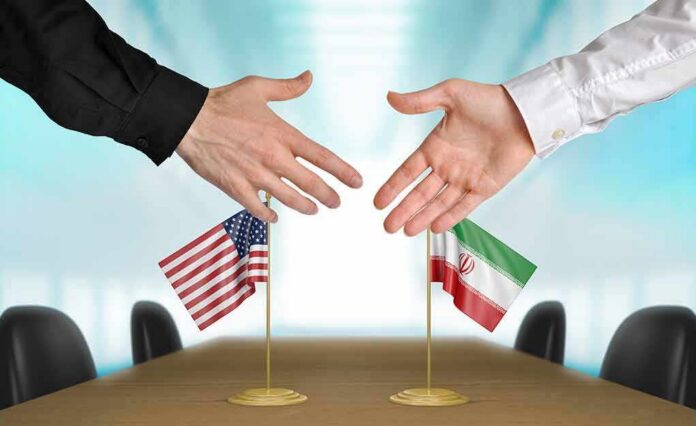
As Washington and Tehran edge toward a war-ending deal, the most dangerous question remains wide open: what really happens to Iran’s growing pile of nuclear fuel?
Story Snapshot
- A 60‑day U.S.–Iran memorandum of understanding would end fighting and reopen the Strait of Hormuz, but leaves key nuclear details unsettled.
- Trump officials say Iran has agreed in principle to dispose of highly enriched uranium, yet the exact removal mechanism is still being negotiated.
- Iran’s past cheating and current stockpile of high‑grade uranium make weak verification a direct threat to American and Israeli security.
- Conservatives remember the failed 2015 Obama deal and want any new terms to enforce real limits, not repeat “trust but get burned.”
Peace Deal Nears, But Nuclear Terms Lag Behind
U.S. and Iranian negotiators have assembled a draft sixty‑day memorandum of understanding that would extend the ceasefire and kick off broader talks to end the war and reopen the Strait of Hormuz.[1] A senior Trump administration official told reporters Iran has agreed in principle to dispose of its highly enriched uranium as part of a two‑step process tied to lifting the naval blockade and easing sanctions.[1] That official stressed the broad template is approved but warned the final legal text still needs work before signatures.
The emerging peace plan would first reopen the Strait of Hormuz in exchange for lifting the United States blockade, then move into tough negotiations over how Iran gives up parts of its nuclear program.[1] Trump has publicly said the deal is “largely negotiated,” but also ordered his team “not to rush,” signalling he is willing to walk if the nuclear piece looks weak.[1] For many conservatives, that patience matters, because they remember how fast the 2015 Iran nuclear deal was sold and how slowly Iran’s cheating came to light.
Disposal Of Enriched Uranium: Hard Details, High Stakes
White House officials admit the hardest issue is still ahead: the exact mechanism for removing or neutralizing Iran’s stockpile of highly enriched uranium.[1] Inspectors believe Iran has hundreds of kilograms of uranium enriched up to 60 percent, close to weapons‑grade, which sharply cuts the time Iran would need to build a bomb if it chose to race.[4] Negotiators are debating where that material goes, who holds it, and how the world verifies it does not quietly return to secret sites.[1]
Past arms control experts note there are only a few real options for dealing with that uranium: ship it out to another country, dilute it back down to low‑enriched fuel, or destroy it on site in a way that makes it useless for weapons. None of those choices are simple, cheap, or risk‑free, especially when dealing with hardened bunkers and underground facilities. Critics of the old Obama‑era deal warn that any plan which lets Iran keep significant enriched material on its own soil, under its own guards, would repeat the same mistakes and leave Israel and the United States exposed.[3]
Why Conservatives Distrust Tehran’s Promises
Iran’s nuclear program has a long record of secret sites, undisclosed material, and delayed inspections that forced the International Atomic Energy Agency to chase the truth after the fact. The 2015 Joint Comprehensive Plan of Action let Iran expand its program over time, including eventual rights to enrich at formerly secret facilities like Fordow and stockpile larger amounts of uranium once “sunset” dates passed.[3] Many analysts argued that deal only “rented” limits for a few years and left a stronger, more legal nuclear program in its wake.[3]
President Trump’s first administration pulled the United States out of that agreement in 2018, calling it a “horrible, one‑sided deal” that should never have been signed.[5] Since then, the International Atomic Energy Agency has reported Iran ramping up enrichment far beyond old limits, including a large and growing stock of 60 percent uranium.[4] For conservative Americans who value strength and honesty over feel‑good diplomacy, those numbers are proof that Tehran responds to weakness by advancing its program and responds to pressure only when it fears real consequences.
Trump’s Red Lines And The Risk Of A “Half Deal”
Current talks focus on three linked nuclear issues: strict verification and transparency, the size and location of Iran’s enriched uranium stockpile, and whether any enrichment is allowed on Iranian soil at all.[4] Reporting indicates the United States has floated a model that would bar enrichment inside Iran and instead push civilian nuclear fuel work to a regional consortium in nearby countries under heavy international supervision.[4] Iranian officials have pushed back, calling the idea unbalanced and vowing to keep some enrichment rights at home, which they frame as a matter of national pride.[4]
That standoff raises a core concern for conservatives: the danger of a “half deal” that stops the shooting and reopens trade, but kicks the nuclear can down the road again. Public briefings already suggest some nuclear details will be left for a later stage, even as sanctions relief and oil export waivers start to flow once the Strait reopens. For Americans who care about national security, Israel’s survival, and stopping radical regimes from getting the bomb, the message is simple: peace on paper means little if the uranium stays in Iran’s hands.
Sources:
[1] Web – Removal of Iranian nuclear materials to be worked out as war deal …
[3] YouTube – Iran’s deputy FM confirms deal with US to end the war …
[4] Web – Deal is reached to end Iran war and Trump orders stop to U.S. naval …
[5] YouTube – Trump Watches UFC as US-Iran Announce End of War …